
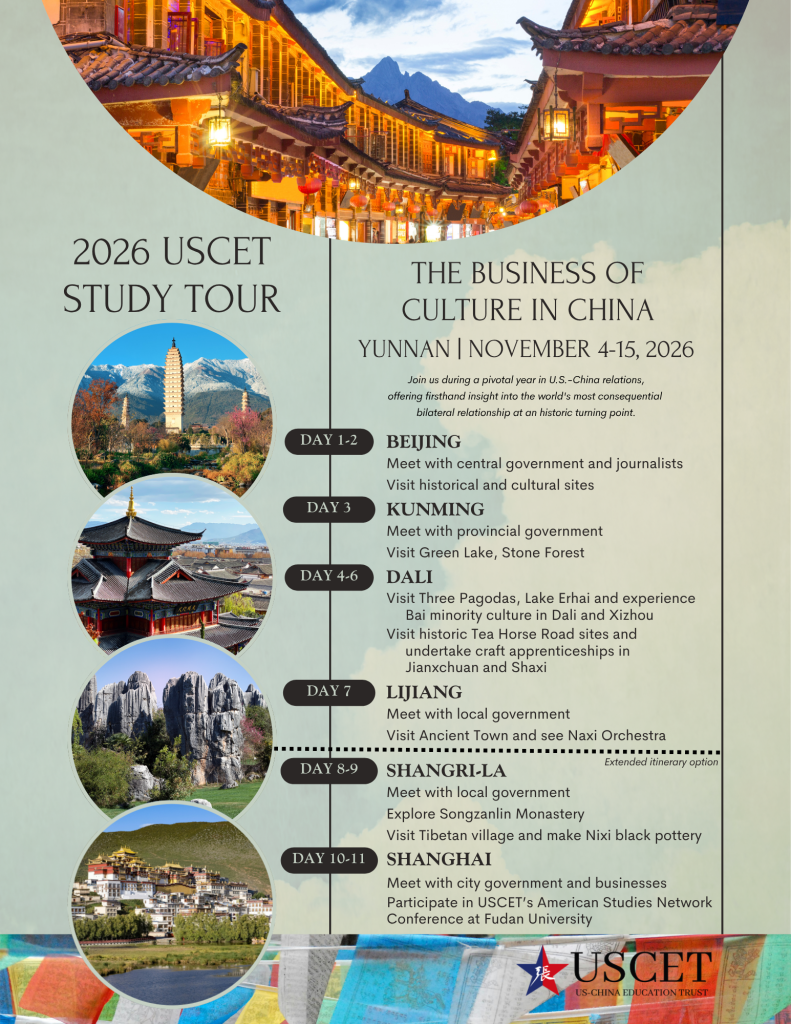
Join us November 4-15, 2026, for USCET’s inaugural China Study Tour during a pivotal year in U.S.-China relations, offering firsthand insight into the world’s most consequential bilateral relationship at a historic turning point.
On this Study Tour, which offers 7-day and 10-day itinerary options, we will journey through China’s cultural and economic crossroads, examining how culture has become one of China’s most dynamic industries — from heritage preservation to cultural commodification and from ethnic tourism to creative entrepreneurship.
Yunnan Province serves as the perfect lens through which to examine China’s complex relationship with cultural commerce. Home to 25 of China’s 56 officially recognized ethnic minorities, Yunnan represents both the richness of China’s cultural diversity and the tensions inherent in transforming living traditions into economic assets. Our itinerary takes us from Beijing’s policy centers to Shanghai’s global markets, with Yunnan’s extraordinary landscape serving as our primary focus.
Itinerary highlights
Beijing | Begin in the nation’s capital to understand the challenges facing U.S.-China relations today, as well as how national policies drive heritage preservation, cultural tourism, and the strategic positioning of culture as “soft power” in China’s global ambitions.
Kunming | Yunnan’s modern capital reveals how provincial cities balance rapid urbanization with ethnic heritage. Visit Yunnan’s Nationalities Village and other sites where culture is curated, packaged, and presented for domestic and international consumption.
Dali | Once the capital of the Bai Kingdom, Dali’s ancient town has become a blueprint for heritage tourism in China. Investigate how traditional architecture, local crafts, and ethnic identity are preserved and performed in one of China’s most visited destinations, as well as in smaller towns like Xizhou, Jianchuan, and Shaxi.
Lijiang | A UNESCO World Heritage Site, Lijiang’s Old Town exemplifies both the benefits and costs of cultural tourism at scale. Analyze how the Naxi minority’s Dongba script, traditional music, and architectural heritage have been transformed into a billion-yuan industry — and what has been gained and lost in the process.
Shangri-La | This city literally renamed itself after James Hilton’s fictional paradise, offering a fascinating case study in place branding and cultural invention. Explore Tibetan Buddhist monasteries and markets where religious artifacts, traditional medicine, and cultural experiences are commercial products.
Shanghai | Conclude by examining how China’s financial, trade, and innovation hub is driving growth through key sectors like finance, high-tech manufacturing, and international commerce, and acting as a crucial gateway for global investment and China’s connection to the world.
Key themes
On tour, we’ll explore the following themes:
- Traditional craft as economic development: From Bai tie-dye to Naxi embroidery, you will observe how artisan traditions are being revitalized, industrialized, and marketed.
- Ethnic tourism and identity: You will examine the complex dynamics of ethnic minorities performing their culture for Han Chinese and foreign tourists. Who controls the narrative? How do communities negotiate authenticity and economic necessity?
- Cultural preservation versus commodification: You will explore the tension between protecting intangible heritage and making it commercially viable. When does cultural tourism preserve traditions, and when does it distort them?
- Yunnan as trade gateway: You will learn about Yunnan’s historical role on the Tea Horse Road and its contemporary position in China’s Belt and Road Initiative, connecting Chinese cultural products with Southeast Asian and global markets.
- Creative industries and innovation: You will discover how young entrepreneurs are reimagining traditional culture — from boutique hotels in heritage buildings to fusion cuisine that honors local ingredients and techniques.
Why travel with USCET?
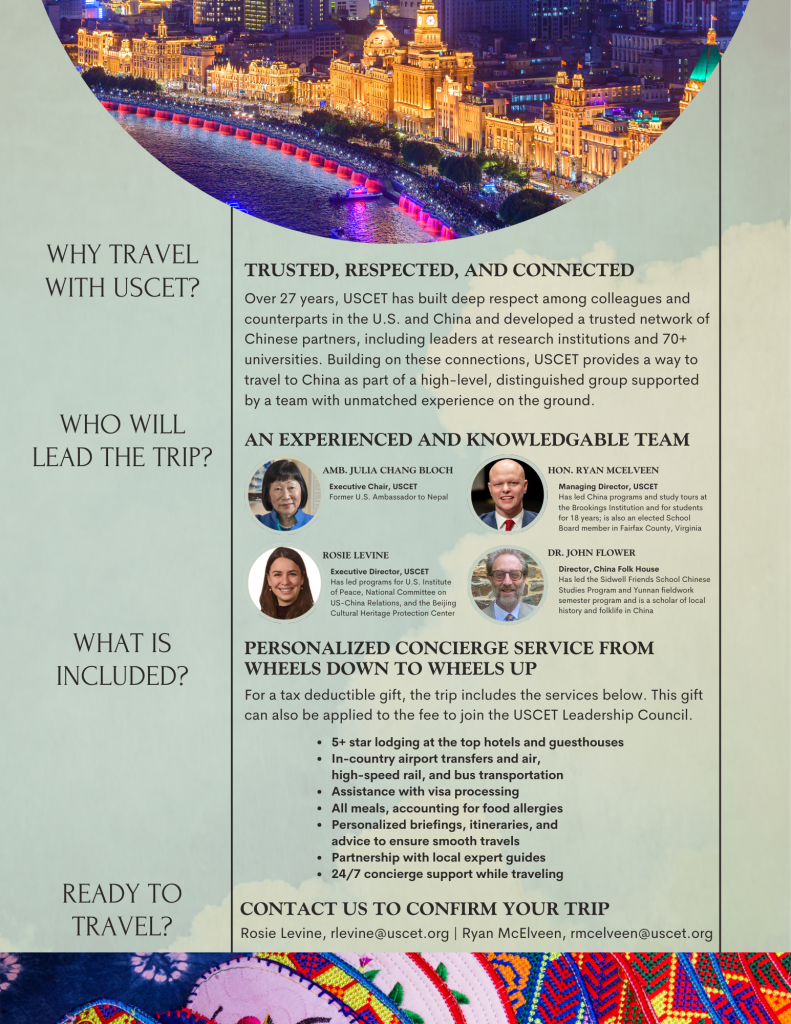
Over 27 years, USCET has built deep respect among colleagues and counterparts in the U.S. and China and developed a trusted network of Chinese partners, including leaders at research institutions and 70+ universities. Building on these connections, USCET’s Study Tour provides a way to travel to China as part of a high-level, distinguished group supported by a team with unmatched experience on the ground.
The trip will be co-led by:
- Amb. Julia Chang Bloch, Executive Chair, USCET
- Rosie Levine, Executive Director, USCET
- Ryan McElveen, Managing Director, USCET
- Dr. John Flower, Director, China Folk House
Please contact us at rlevine@uscet.org and rmcelveen@uscet.org for more information and to reserve your spot on the tour!