
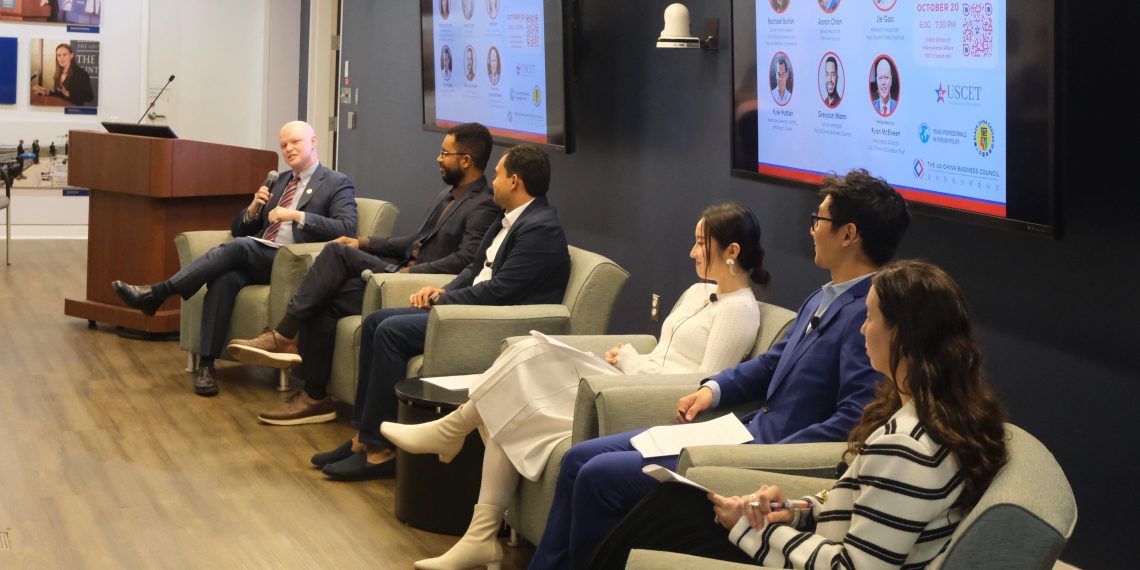
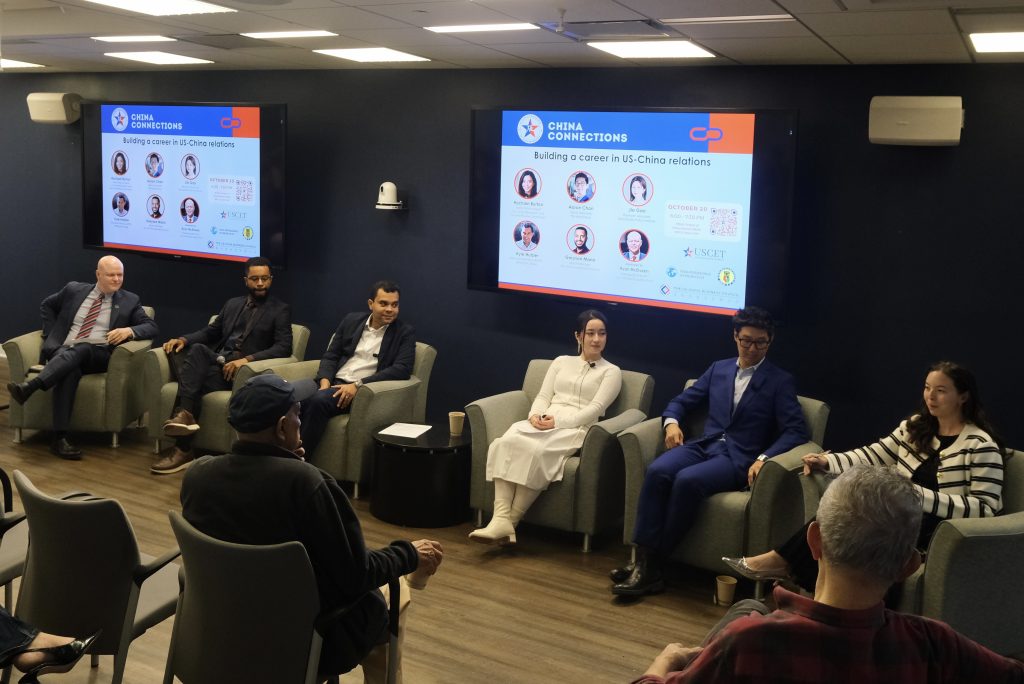
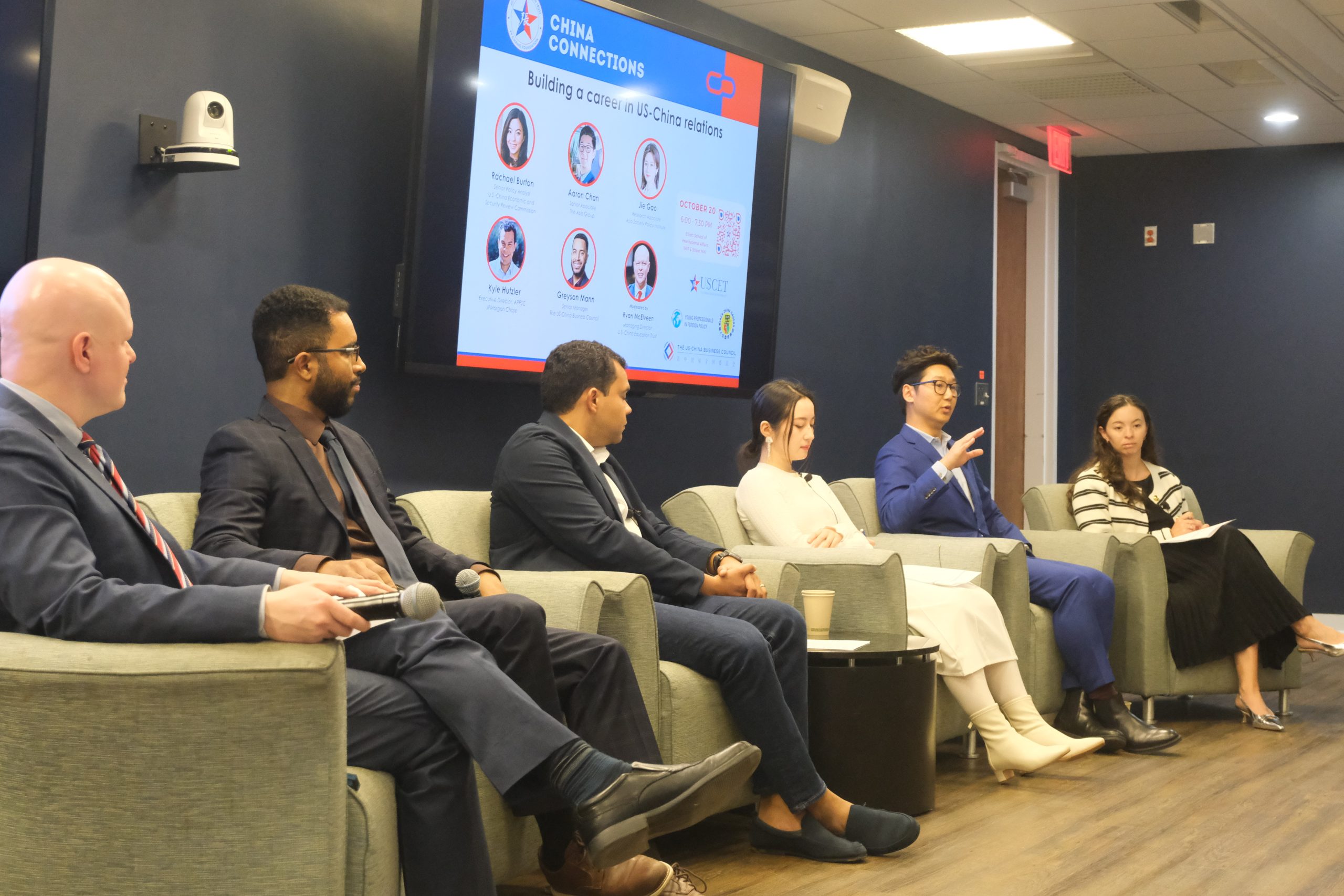
On October 20, USCET hosted a panel discussion as part of its China Connections series that brought together five young professionals working at the intersection of U.S.–China relations. Moderated by USCET Managing Director Ryan McElveen, the event explored how each speaker entered the field and adjusted their trajectories, and the insights they’ve gleaned along the way. The panelists – Rachel Burton, Aaron Chan, Jie Gao, Kyle Hutzler, and Greyson Mann – shared candid reflections on the evolving opportunities and challenges in building a China-focused career today.
USCBC President Sean Stein opened the event by underscoring a core message: there is still a strong market for U.S.–China expertise, but the nature of the demand is evolving. Opportunities remain, but the bar for entering the field has risen, requiring more functional skills, a clearer purpose, and a willingness to adapt. Those who can bridge divides between the two countries, he noted, continue to be indispensable.
McElveen opened the discussion by saying that “It is rare that we have the opportunity to sit down with young professionals in foreign policy and speak about their careers. Usually this and other stages are reserved for those who have been around for – frankly – a long time and have lost touch with what it’s like to seek jobs in this increasingly competitive and – at least at this moment – shrinking field. Not tonight.”
The panelists shared diverse entry points into U.S.–China work. Rachel Burton began her career with Teach for China, where she was the only foreign teacher in rural Yunnan. Having to manage over 60 students and think on her feet daily, the experience built her hard skills quickly and shaped how she later approached project work at the Tsinghua Carnegie Center and in Washington. Aaron Chan spoke about entering a bleak job market during COVID and using that time to build a cohesive professional narrative across communications, political economy, and cybersecurity. His advice: don’t build a plane as you are flying through a hurricane, prepare thoughtfully at every step, and be intentional in your outreach and upskilling.
Jie Gao emphasized persistence in the face of rejection. She applied to many positions, conducted informational coffee chats, and focused on showing value, like building databases and visualizations for Taiwan-focused research and contributing to “PLA Watch” analysis. Kyle Hutzler, a member of the inaugural class of Schwarzman Scholars, highlighted the program’s alumni network and its core insight: being a China specialist today means enabling cross-border understanding, even when China isn’t the sole focus of your role. Greyson Mann noted that while his path included roles at Princeton in Asia, the Department of Education, and USCBC, the throughline was sincerity: showing care through language learning, staying flexible, and seeking to engage with humility and purpose. When asked what sparked their interest in China, several panelists described personal and historical turning points. For Chan, his interest in China is rooted in his heritage, and the country’s growing Belt and Road involvement in Africa became an early pivot point that shaped his regional focus. Burton had originally envisioned a career in counterterrorism, but a mentor’s advice, pointing to Asia as the new strategic frontier, changed her course. Hutzler’s understanding of China’s impact crystallized while working at the U.S. International Trade Commission before the trade war. For Mann, the motivation was more internal: discovering his purpose and trusting that investing in language and regional knowledge would open doors in ways he couldn’t yet predict.
The panel also stressed that topics are cyclical. Burton reminded attendees that while Asia may not always be at the center of the national interest, the landscape can change. Young professionals should not be discouraged by short-term shifts in attention.
“Not every job labeled ‘international relations’ is the real thing.”
On preparing for a China-focused career, panelists emphasized a balance of topical expertise and transferable skills. Gao encouraged attendees to try publishing early, even if the bar feels high—it builds credibility. Hutzler spoke to the value of maintaining proximity to the field, even when one’s day job isn’t China-specific. Chan emphasized knowing what’s out there, being aggressive in your research, and staying curious.
In discussing functional vs. topical expertise, Burton noted the value in understanding how U.S. policy decisions are made and not just the subject matter itself. Mann added that hindsight may offer clarity, but in the moment, it’s more important to stay grounded and ask what changes might shape the future. Everyone agreed: thoughtful positioning and flexibility matter more than a rigid path.
Each panelist then spoke about the role mentors played in shaping their trajectories. From former professors to managing directors to family members, mentors often saw potential before the panelists saw it in themselves. Several cited the importance of peers as mentors—people who create space for others, offer honest feedback, and encourage confidence without ego.
When asked about the most important skills for success in a China–related career, panelists emphasized a mix of analytical, communication, and interpersonal strengths.
- Burton pointed to writing, research, and especially communication, ie. knowing how to frame problems and explain complex ideas clearly.
- Chan emphasized the importance of effective communication across contexts.
- Gao named research skills as foundational, especially when paired with curiosity.
- Hutzler said empathy was essential, not just for cross-cultural work, but for understanding policy impact and stakeholder needs.
- Mann highlighted the ability to present ideas in a way that captures people’s interest, noting that communications is often what brings research and policy work to life.
All agreed that in both mentorship and skill-building, success in the field depends not only on knowledge but also on the ability to connect with people, adapt one’s voice, and create value across cultural and institutional divides.
When McElveen asked the group whether, given the geopolitical situation and security concerns, they would recommend that students today study abroad or work in China, there was unanimous support for continuing study and work abroad in China, even amid the challenging circumstances today. A majority said that – if they could go back to school – they would focus more on STEM subjects. However, paradoxically, the group tended to agree that qualitative analysis and skills like empathy, writing, synthesis remain most important to a career in the field, even as universities trend toward promoting quantitative-focused analysis.
During the Q&A session, panelists compared the current generation of China experts to the prior ones. While earlier experts benefited from stronger in-country networks, today’s professionals have far greater access to open-source information, so the challenge now lies in filtering, interpreting, and synthesizing what’s available. As for the future of U.S.–China relations, the panelists highlighted new areas of competition and cooperation—from space and strategic technology to cryptocrimes and defense. They also emphasized the growing importance of secondary and spillover regions, particularly in Southeast Asia and Africa. On removing bias in research, panelists encouraged attendees to read widely, including perspectives that challenge their own, and to understand the full spectrum of debate before forming conclusions.
The discussion closed on a note of encouragement. While the China field may look different than it did 10 or 20 years ago, the need for thoughtful, well-prepared professionals has not diminished. As Sean Stein noted at the beginning, opportunities still exist, but they require sharper tools, clearer thinking, and deeper sincerity. Whether through policy, business, education, or civil society, there is still room to build bridges. The panelists encouraged the audience to stay curious, move forward with purpose, and trust in the path they have been bold enough to create for themselves.
Speaker Biographies
Panelists

Rachael Burton is a senior policy analyst on the security and foreign affairs team at the Commission. She previously served in the Office of the Secretary of Defense (OSD) from 2019 to 2023 as the Country Director for China. Prior to joining the Department of Defense (DoD), she was the Deputy Director at the Project 2049 Institute, where she managed the Institute’s research and programming. She has previously worked at the Carnegie China Center and the National Bureau for Asian Research.
Rachael acquired her MA in Security Studies from Georgetown University. Prior to joining the Master’s cohort at Georgetown, she earned her Bachelor of Arts degree in International Relations and Conflict Resolution from George Washington University. Rachael spent two years working in a remote rural village in China’s Yunnan Province, where she taught English at a public Middle School. She reads and speaks Chinese.
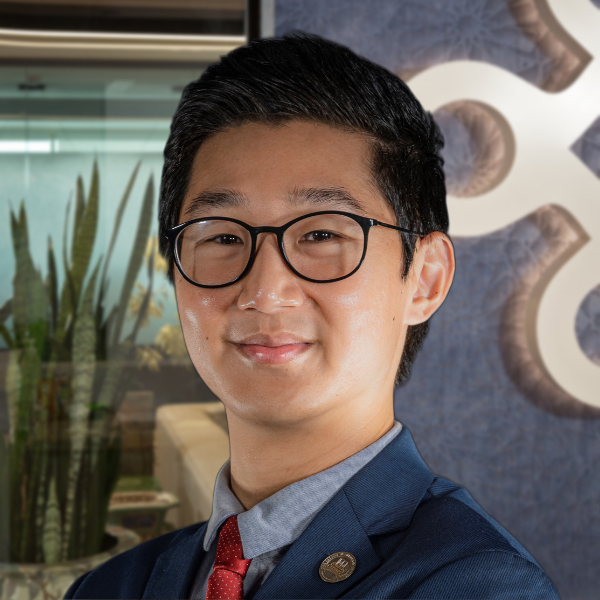
Aaron Chan is a senior associate at The Asia Group, where he advises clients on the Indo-Pacific’s policy, investment, and geopolitical landscape. As part of the Geopolitics and Research team, he contributes to the firm’s thought leadership through special reports and the Daily Asia newswire. Previously, he served as Special Advisor to the National Cyber Director, advancing the President’s National Cybersecurity Strategy and leading congressional engagement on legislation to strengthen U.S. cybersecurity. His prior roles span FEMA, the U.S. Senate, the U.S. House of Representatives, and the East-West Center.
With a decade of experience at the intersection of national security, U.S. foreign policy, and the political economy of the Indo-Pacific, Aaron has focused on environmental impacts on development, U.S.-China strategic competition, and regional dynamics in Southeast Asia and the Pacific. He has represented the U.S. at international fora such as the G20 Youth Summit, UN Water Conference, and UN Summit of the Future. Aaron holds a BA in Global Studies from UCLA and an MA in International Affairs from George Washington University, and has lived, studied, and worked in China and Hong Kong.
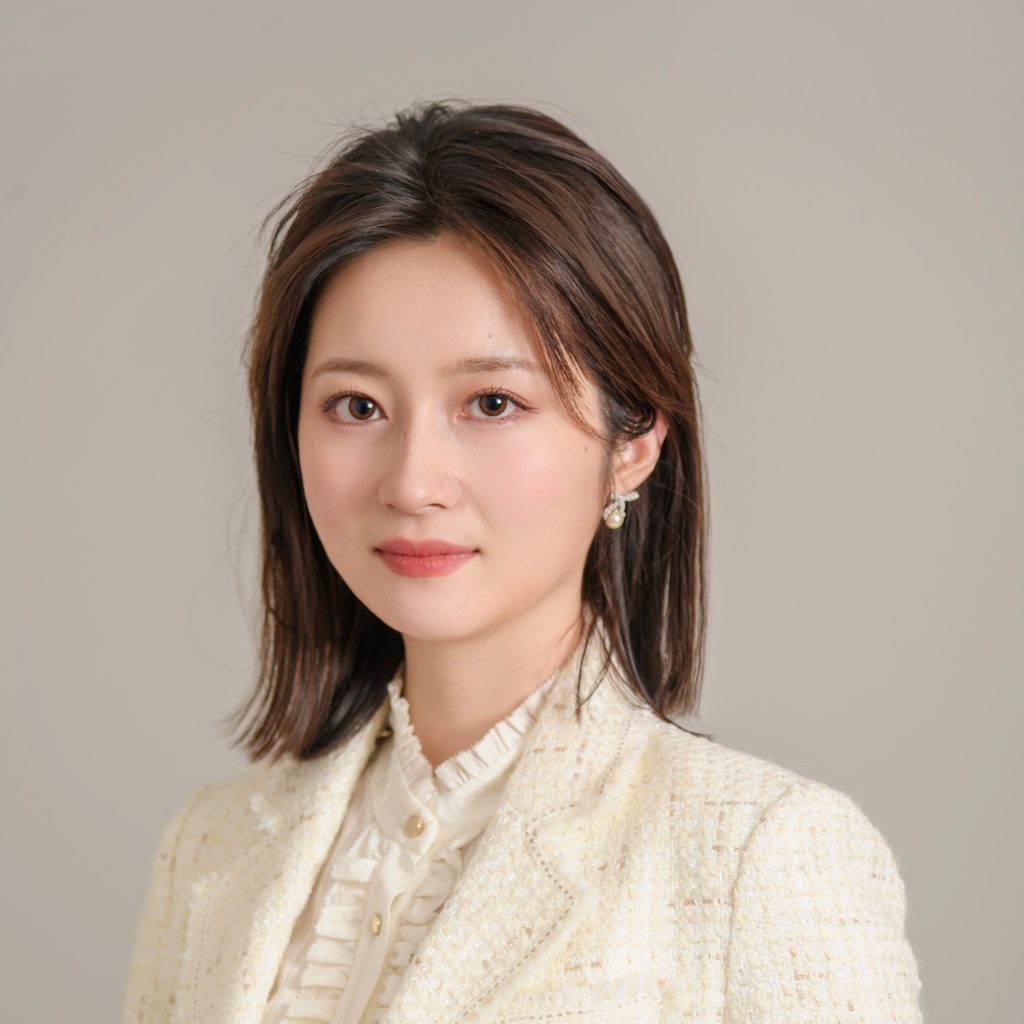
Jie Gao is a research associate on foreign policy and national security at the Asia Society Policy Institute’s (ASPI) Center for China Analysis (CCA). Prior to joining CCA, Jie had internships at U.S. and Chinese think tanks, including the Brookings Institution and the Center for Strategic and International Studies. She holds an MA in Security Studies from Georgetown University’s Walsh School of Foreign Service, and a BA in Political Science from Bryn Mawr College.
Kyle Hutzler serves as the executive director of asia pacific policy and strategic competitiveness for JPMorgan Chase. In this role, he advises the firm’s senior leaders and clients on geopolitics and economic statecraft issues and engages government stakeholders on economic security and competitiveness topics.
Kyle was previously a consultant with McKinsey & Company and began his career at the US International Trade Commission. He has also served as a strategist at the South China Morning Post. Kyle has authored multiple studies, including on supply chain risk, American city diplomacy, and China’s interference operations. Kyle holds a BA in Economics from Yale, an MA in Global Affairs from Tsinghua, and an MBA from Stanford.
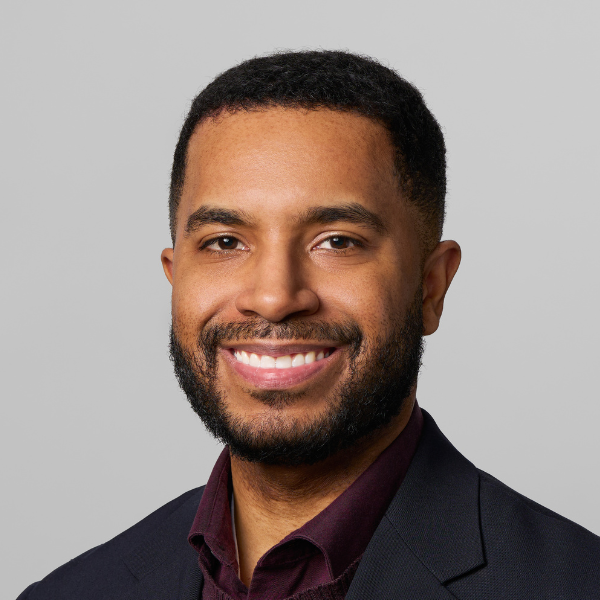
Greyson Mann is a senior manager of government affairs at the US-China Business Council. He previously served as a Founding Team Member and Assistant Director of Whittle School & Studios’ Center of Excellence on International Cooperation. He also previously served as an appointee in the Obama administration’s Department of Education Center for Faith-based and Neighborhood Partnerships. He has also worked in the tech sector at Chainbridge Technologies and Digital Promise.
He is a member of the National Committee on US-China Relations and is also the Director of Research for the Black China Caucus. He holds a Master’s in International Trade and Economic Diplomacy from the Middlebury Institute of International Studies. He attended Wofford College for his bachelor’s, where he received a Princeton in Asia Fellowship. He speaks Chinese and has lived in Beijing and Shanghai.
Moderator
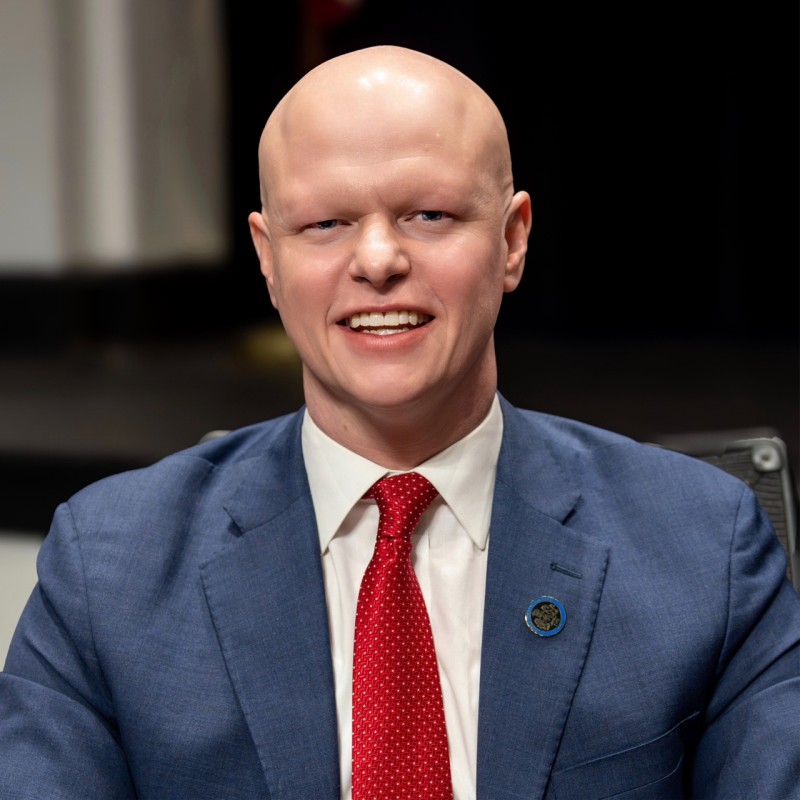
Ryan McElveen (麦瑞安) serves as the managing director for the U.S.-China Education Trust.
Before joining USCET, Ryan served for 12 years as associate director of the John L. Thornton China Center at the Brookings Institution, where he supported a team of scholars, research staff, and interns; launched and coordinated the U.S.-China Leaders Forum at Sunnylands and U.S.-China track II dialogues; implemented large-scale research projects; hosted public events, retreats, and study tours in the U.S. and Asia; initiated the Brookings China Council and managed donor relations; oversaw partnerships with other global think tanks and academic institutions.
Ryan is serving in his third term as an at-large member of the School Board in Fairfax County, Virginia. Ryan has advocated for internationalizing the curriculum, increasing global language programs, and enhancing student civic engagement. Ryan is the founder and managing director of the Global Leaders of Fairfax County program, which prepares high school seniors to be global citizens and change agents in their community and the world.
China Connections
Why should Americans be interested in China? USCET launches China Connections, a new monthly series hosting discussions with experts to explore their work, gain insights into current events, and learn what a career in the China field looks like today. These events highlight individuals with unique expertise on China to provide students, young professionals, and members of the public a deeper understanding of current events and increase American student interest in pursuing a focus on China. These events are mostly held in person at George Washington University with online engagement.