
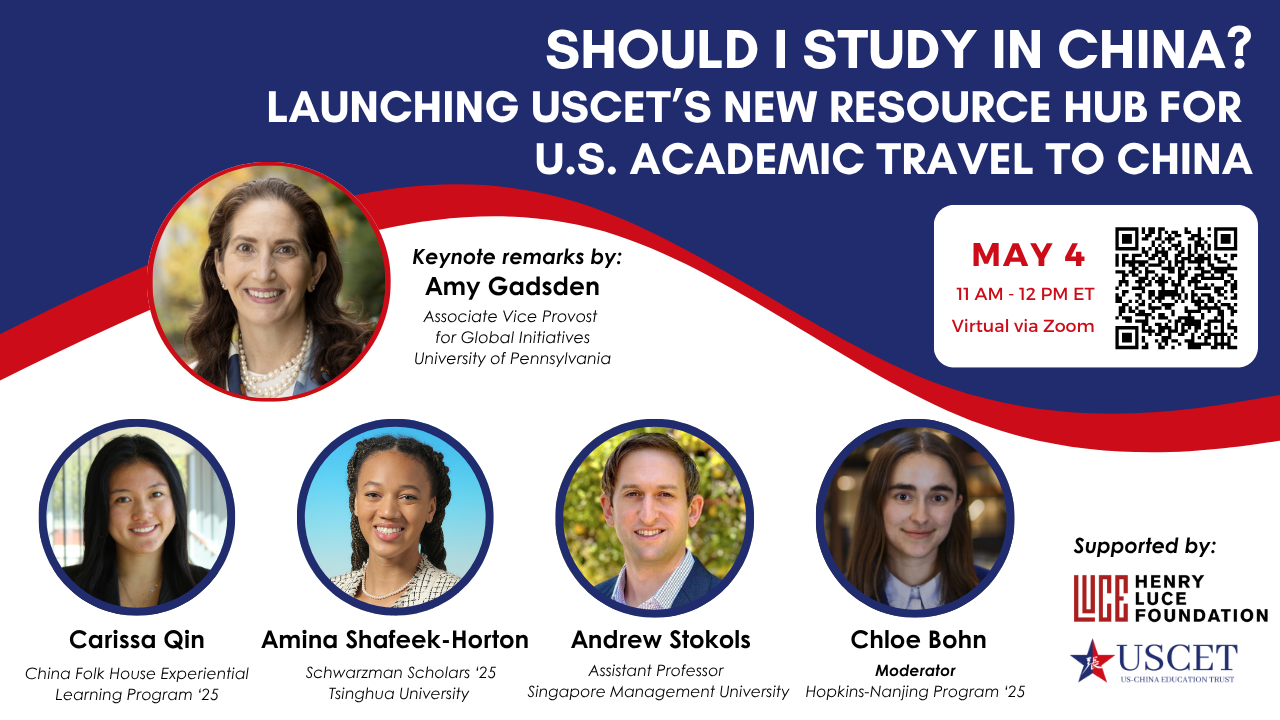
Are you a student, scholar, or researcher curious about studying or conducting fieldwork in China but not sure where to start? Join the US-China Education Trust (USCET) on Monday, May 4 from 11:00 am -12:00 pm ET for a virtual event launching USCET’s Resource Hub For U.S. Academic Travel to China, a comprehensive guide and compendium of active funding sources, fellowships, and programs to support U.S. academic travel to China.
The Resource Hub is a timely resource to strengthen the U.S. bench of China expertise following the release of USCET’s 2026 America’s China Talent Challenge report, which revealed that fewer than 2,000 Americans are currently studying in China each year. Whether you are weighing joining your first summer study abroad program or planning a multi-year research project, the USCET Resource Hub can provide clear, practical guidance to assist you in your planning.
The event will open with keynote remarks from Amy Gadsden, Associate Vice Provost for Global Initiatives at the University of Pennsylvania, followed by an Ask Me Anything panel discussion session moderated by Chloe Bohn and featuring Amina Shafeek-Horton, Carissa Qin, and Andrew Stokols, who will share their perspectives on their recent experiences studying and conducting research and China, as well as why American engagement in China matters now and what pathways are available to students and scholars today.
Speaker Biographies
Speaker
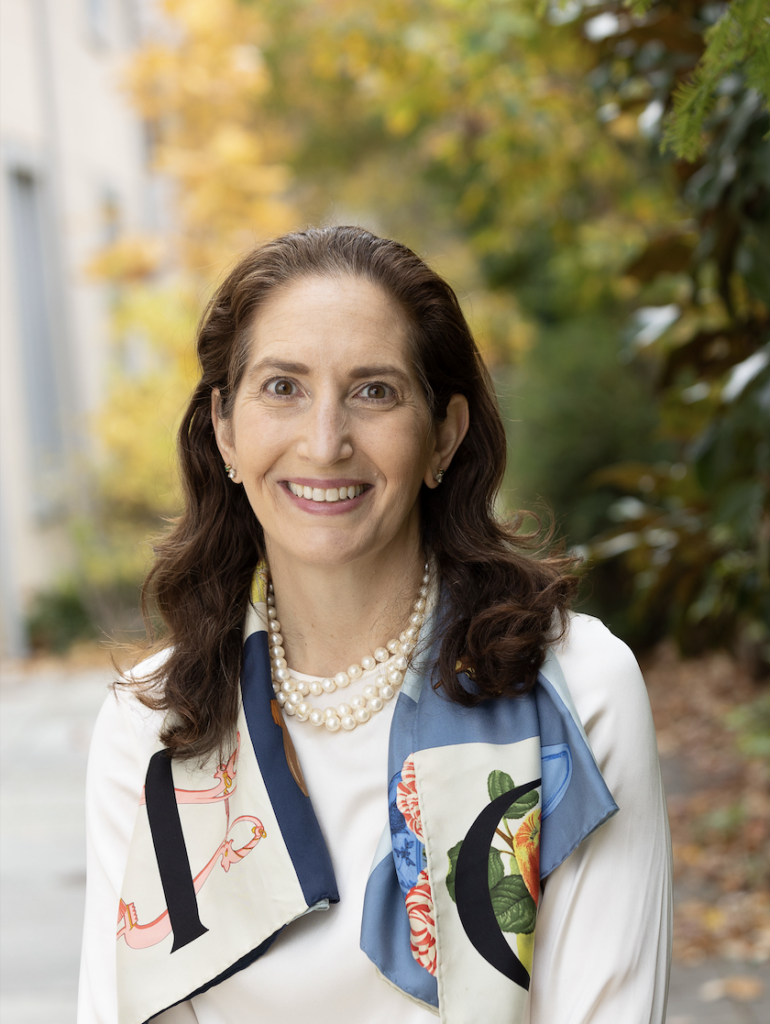
Amy Gadsden is the Associate Vice Provost for Global Initiatives at the University of Pennsylvania. Gadsden has spent more than a decade working in the foreign policy field with a focus on China. She served as a Country Director for the International Republican Institute and as a Special Advisor for China at the United States Department of State. Early in her career, she published several articles on democracy and human rights in China, documenting changes in legal and civil society reform. Dr. Gadsden was one of the first American scholars to observe and write about grassroots elections in the PRC in the mid-1990s.
She holds a B.A. from Yale College and a Ph.D. in Chinese legal history from the University of Pennsylvania and serves on the board of the William Penn Charter School.
Moderator

Chloe Ross Bohn is a program coordinator at the DC Coalition to End Sexual Violence. She previously worked with the U.S.-China Education Trust, where she helped develop the “Resource Hub For U.S. Academic Travel to China,” supporting U.S. students and scholars navigating academic engagement in China. Chloe holds an MA from the Johns Hopkins School of Advanced International Studies (SAIS) and studied at the Hopkins-Nanjing Center.
Panelists
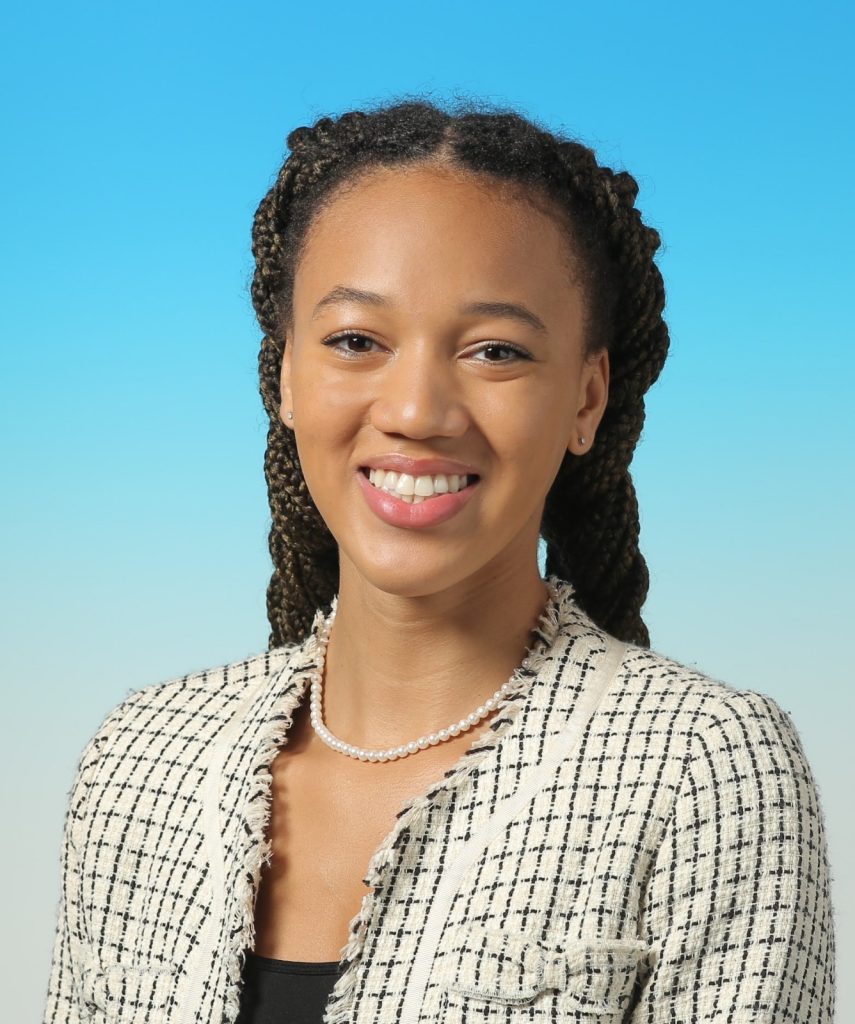
Amina Shafeek-Horton is a Schwarzman Scholar and earned a master’s degree in Global Affairs from Tsinghua University in Beijing. She holds three bachelor’s degrees in business through the World Bachelor in Business program, studying at the University of Southern California, the Hong Kong University of Science and Technology, and Bocconi University in Milan. She most recently served as a program associate at the United Nations Foundation, supporting the Council of Women World Leaders, and was a Carnegie China Young Ambassador at the Carnegie Endowment for International Peace. Her experience also includes internships with the American Chamber of Commerce in Hong Kong and Pfizer. She is fluent in Mandarin Chinese.
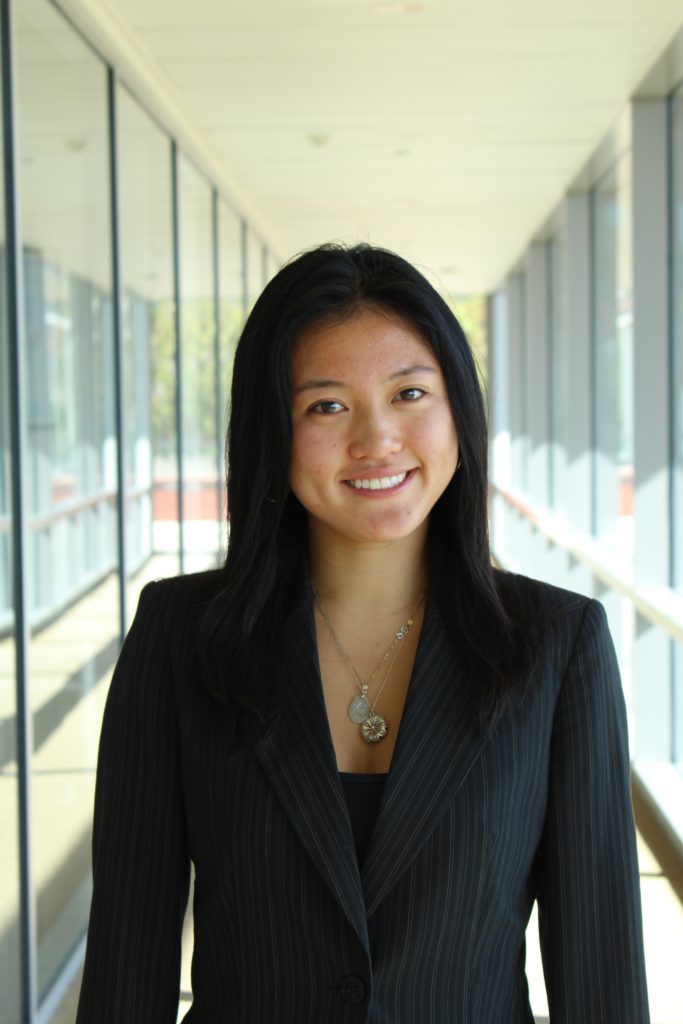
Carissa Qin is a rising junior at Claremont McKenna College pursuing a dual major in PPE (Politics, Philosophy, and Economics) and Economics. Last summer, she travelled to Yunnan, China as an Appel Fellow to conduct fieldwork as part of the China Folk House Experiential Learning Summer Program. As part of the program, she travelled throughout rural Yunnan investigating the architecture of traditional homes, cultural practices, farming, and the impact of hydropower dams.
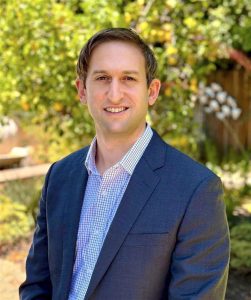
Andrew Stokols is Assistant Professor of Urban Studies and Urban Fellow (Urban Governance) at Singapore Management University.
His research examines the social and political dimensions of digital urbanism globally, with a particular focus on China and Southeast Asia. Drawing on urban theory, political economy, and science and technology studies (STS), his work explores how technology shapes urban governance and development. He also leads ongoing projects on the political economy of new city development, the geopolitics of infrastructure, state capitalism, and digital innovation policy.