
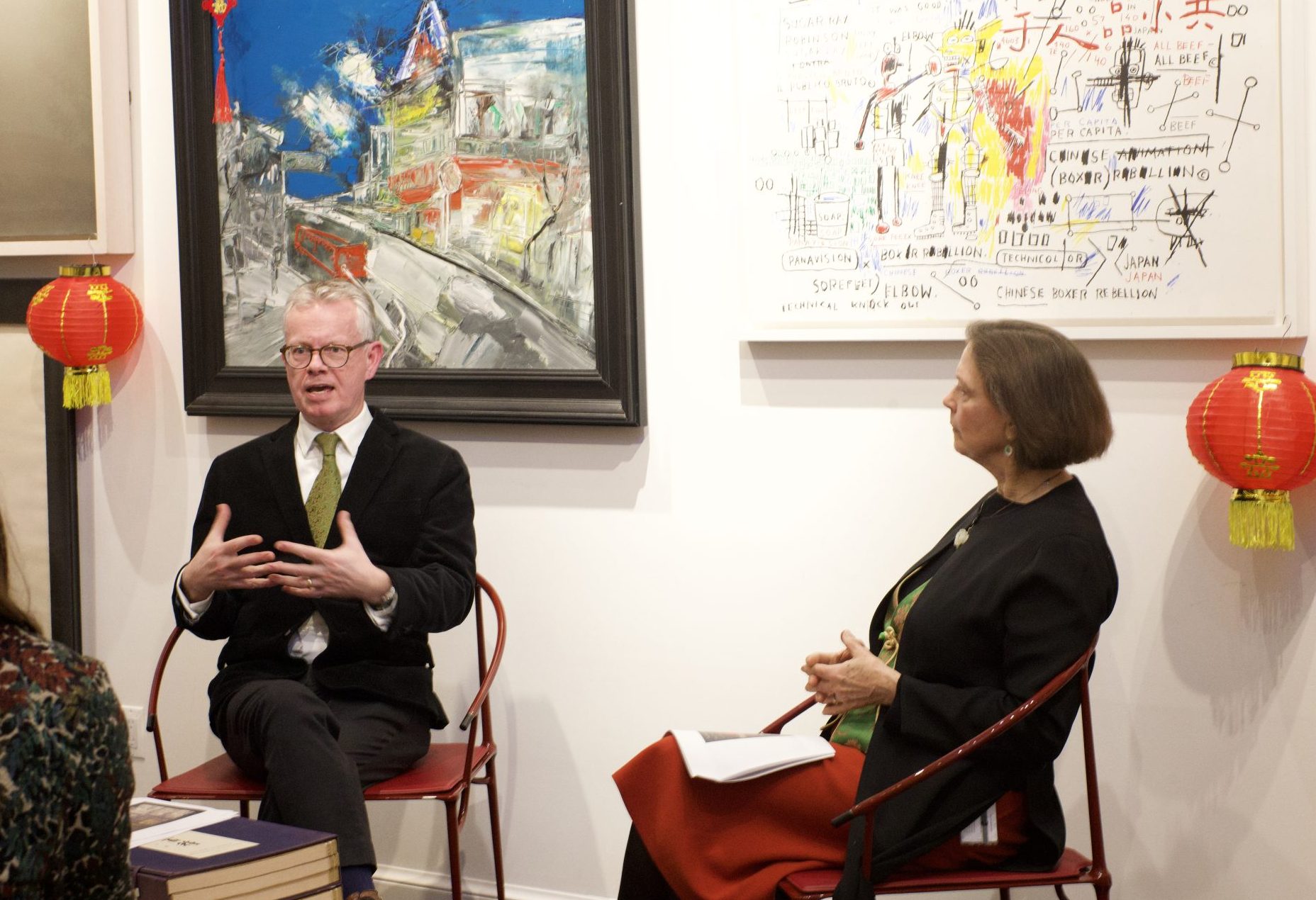
On February 24, USCET held the inaugural convening of the USCET Salon Series featuring author Adam Brookes in conversation with curator Jan Stuart. The evening brought together a distinguished group of guests — diplomats, scholars, art historians, and curators — united by a shared interest in the U.S.–China relationship and the cultural histories that connect the two countries. The evening centered on a presentation by and conversation with Adam Brookes detailing a poignant chapter in the history of modern China: the wartime rescue of China’s most precious treasures from the Forbidden City.
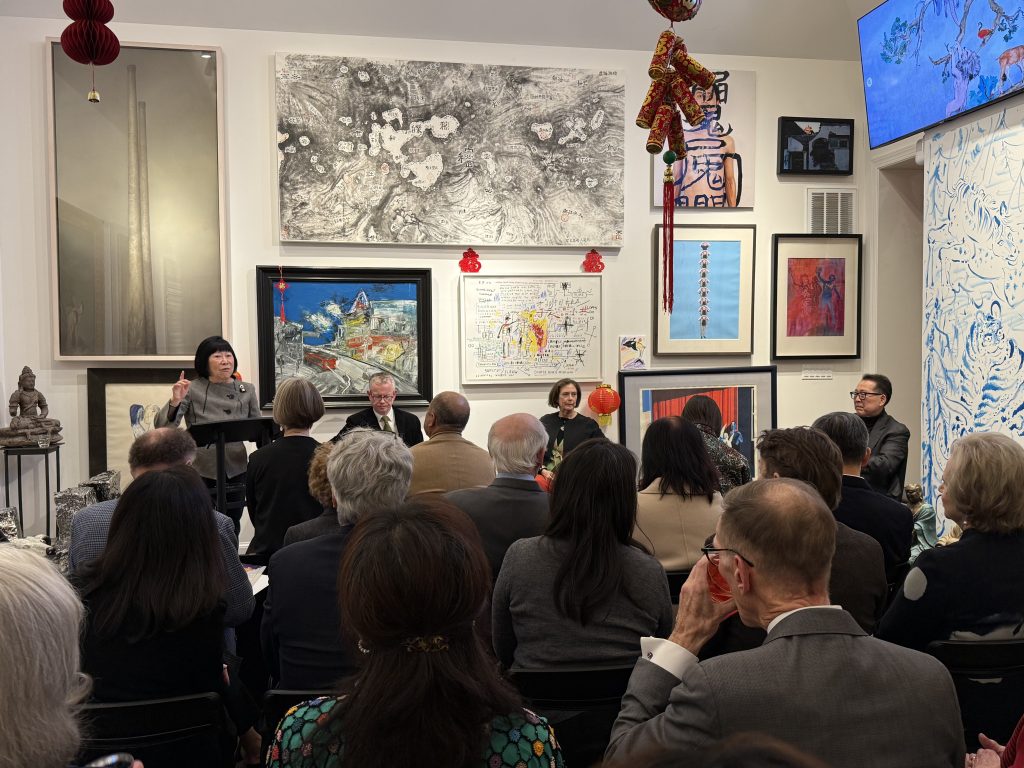
The gathering was held at the home of Handel and Jennifer Lee, which provided an elegant and uniquely fitting backdrop for the evening — a space alive with art, history, and personal meaning.
To open the program, Ambassador Julia Chang Bloch, USCET founder and Executive Chair, welcomed guests to the launch of this series of intimate gatherings dedicated to exploring Chinese art, heritage, and culture. She reflected on the threads of personal and historical memory that ran through the evening: the artwork of Dora Fugh Lee — a pioneering Chinese American artist and the mother of their host, Handel Lee — her own family’s ties to China in the 1930s and 1940s, and the extraordinary story about to be told.

The centerpiece of the program was a presentation by Adam Brookes on his book Fragile Cargo: The World War II Race to Save the Treasures of China’s Forbidden City. Drawing on meticulous archival research, Brookes recounted how, in the spring of 1933, with Japanese troops advancing on Peking, the curators of the Forbidden City made the decision to evacuate the imperial collections — over 250,000 works of art, among them the Stone Drums of Qin bearing 2,500-year-old inscriptions, thousand-year-old paintings on silk, and rare Ming porcelains. Packed into wooden cases and loaded onto trucks, the collections traveled 15,000 miles over sixteen years — ferried across rivers, pushed over mountain passes, moved through burning cities — under the quiet leadership of museum director Ma Heng, as war swept across China.
Jan Stuart, curator of Chinese art at the Smithsonian’s National Museum of Asian Art, then joined Brookes for a fireside chat that carried the conversation further — into the fate of the collections after the Chinese civil war concluded. When the Chinese Communist Party came to power in 1949, the Nationalist government took a portion of the imperial collections to Taiwan, where they remain today in the National Palace Museum in Taipei while the remaining pieces stayed on the mainland. Split by a political divide that has never been resolved — and with it, questions about inheritance, legitimacy, and what it means to be the proper custodian of Chinese artistic memory, the treasures carry with them more than cultural weight, but historical trauma and scars that linger through generations.
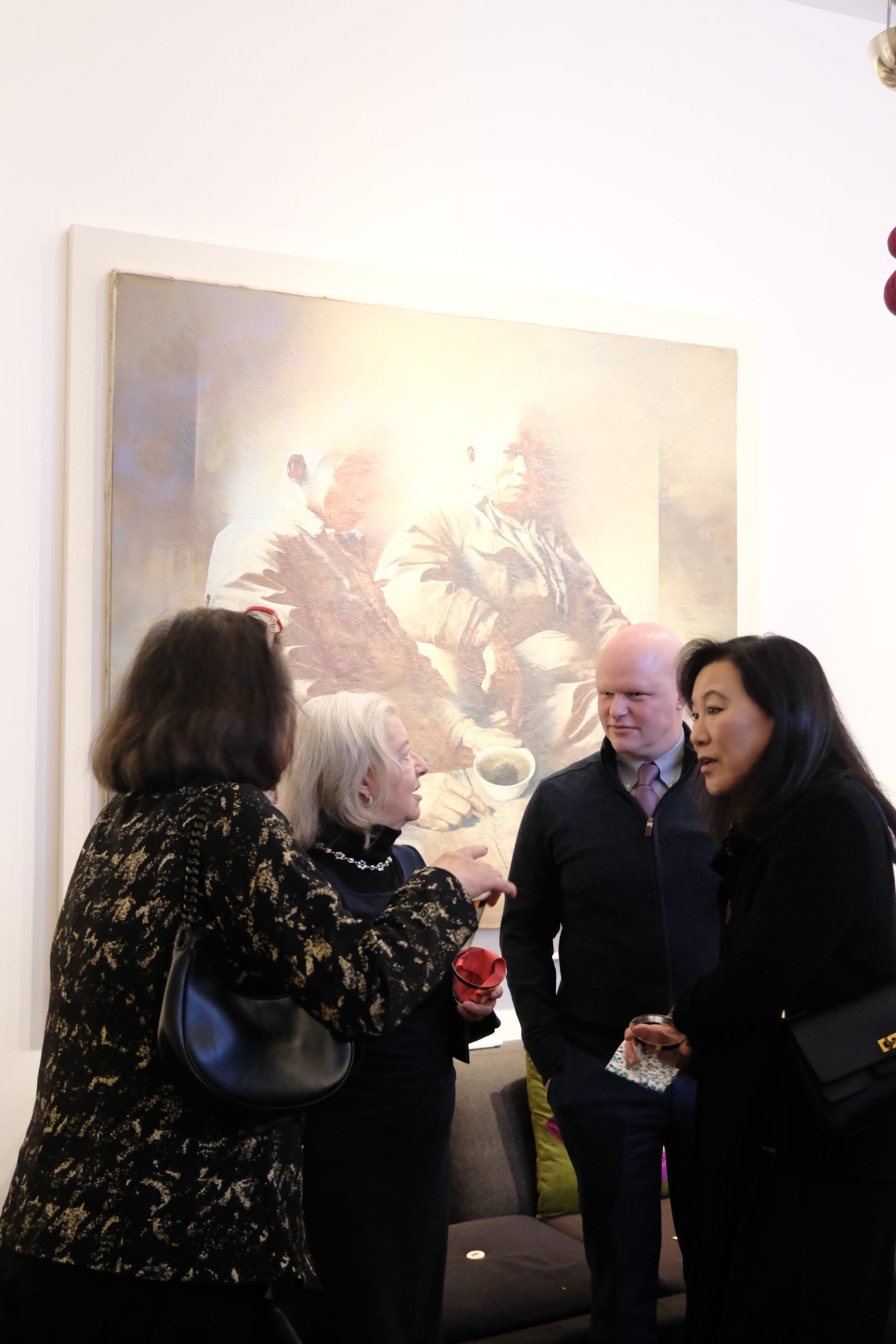
The evening then transitioned to an open Q&A session, with guests raising the broader questions the story invites: How Chiang Kai-shek decided to divide the collection between Beijing and Taipei, what it means for two institutions — the Palace Museum and the National Palace Museum — to steward different portions of the imperial inheritance, and how 16 years of extraordinary effort to keep these objects together sits alongside the separation that followed.
Speaker Biographies
Speaker
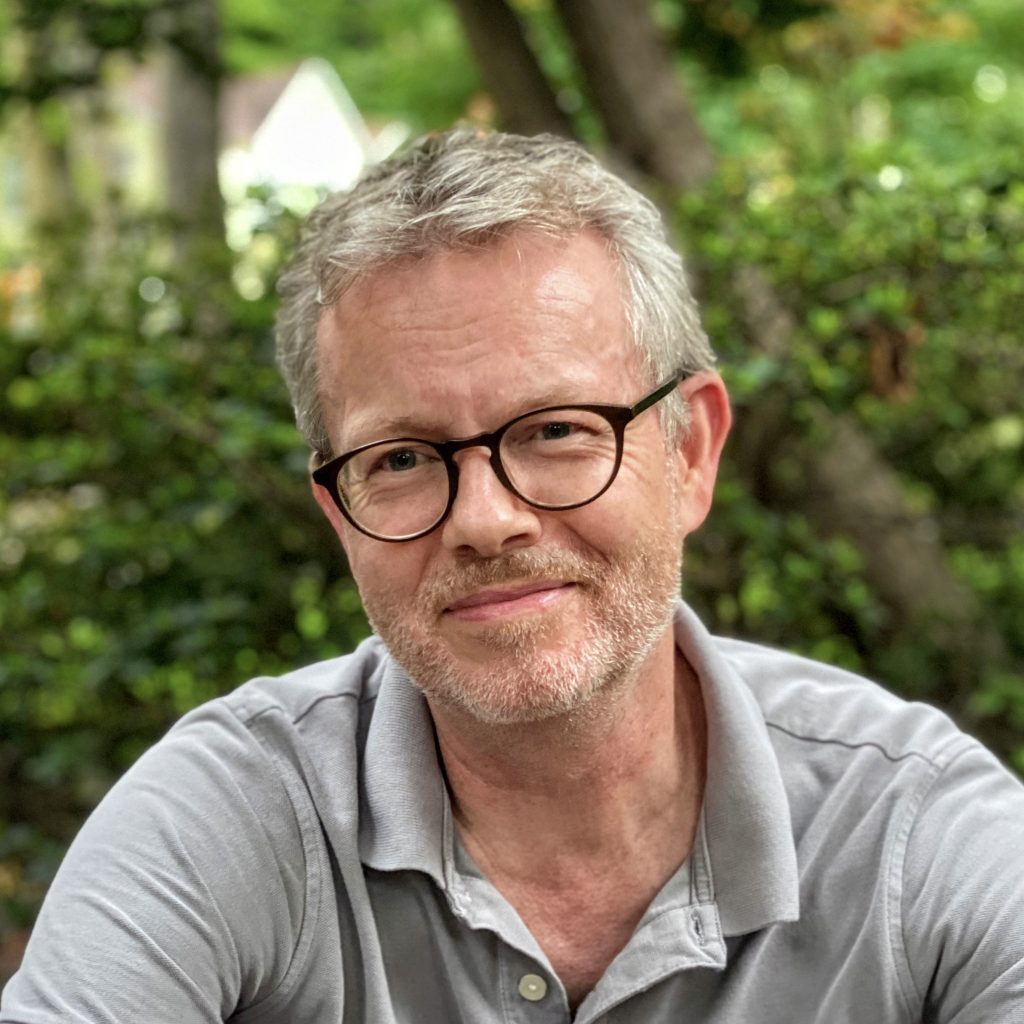
Adam Brookes is the author of Fragile Cargo: The World War II Race to Save the Treasures of China’s Forbidden City. He is an author whose writing draws on his years in China and his study of Chinese, as well as his years as a journalist and foreign correspondent. Adam was born in Canada, but grew up in the UK. He studied Chinese at SOAS, University of London. His first job in broadcast journalism was as a copytaster at the BBC World Service, a job now extinct. Over two and a half decades in journalism he worked mainly for BBC News as Jakarta correspondent, Beijing correspondent and Washington correspondent, and reported from many other places, including Iraq and Afghanistan. He lives in the United States.
Moderator
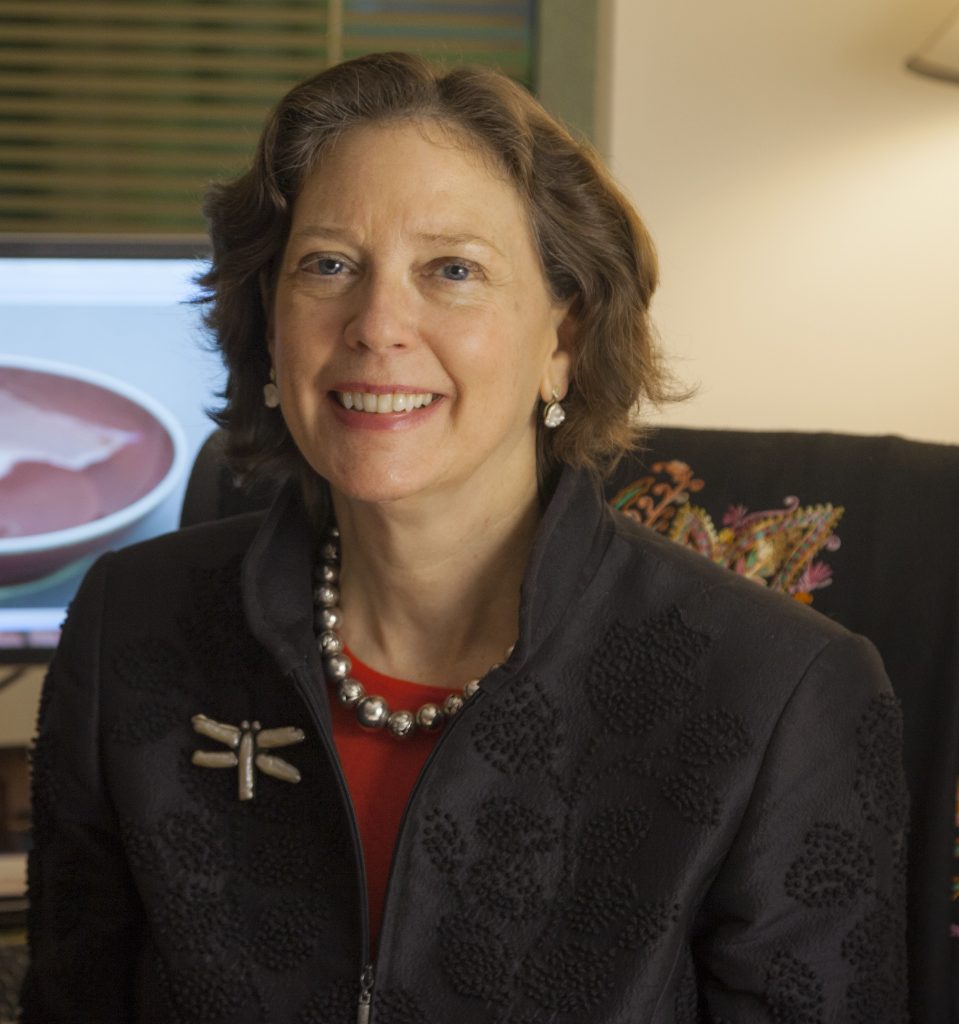
Jan Stuart is the first Melvin R. Seiden Curator of Chinese Art at the Smithsonian’s National Museum of Asian Art, where she oversees one of the most significant collections of Chinese art in the Western world. A scholar of Chinese painting, decorative arts, and material culture, Stuart has dedicated her career to illuminating the histories, meanings, and human stories embedded in objects of enduring beauty.