
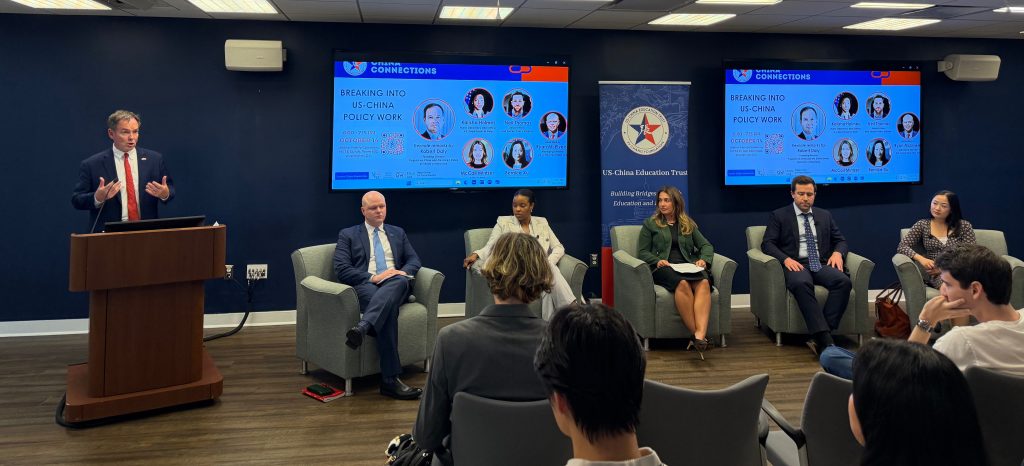
On October 14, the U.S.-China Education Trust (USCET), in partnership with the Sigur Center for Asian Studies, the Elliott School Graduate Student Services, Young China Watchers, and Career China Newsletter, hosted a career panel on breaking into U.S.-China policy work. The program featured keynote remarks by Robert Daly, founding director of the Program on China and the United States at the University of Maryland, as well as a panel discussion with Kalisha Holmes, public diplomacy desk officer at U.S. Department of State; McCall Mintzer, Boeing chief of staff for international operations and policy; Neil Thomas, senior fellow at the Asia Society Policy Institute; Bernice Xu, senior associate for defense and national security at The Asia Group; and moderated by Ryan McElveen, managing director at the U.S. China Education Trust.
Robert Daly opened the event by highlighting the increasing difficulties of entering the U.S.-China policy space, as the field has both high barriers to entry and significant uncertainty regarding job availability. Decreasing interactions between the United States and China, growing homegrown Chinese talent, AI threats, coupled with the fact that many U.S. policies toward China are not shaped by China experts, further complicate entering U.S.-China policy work.
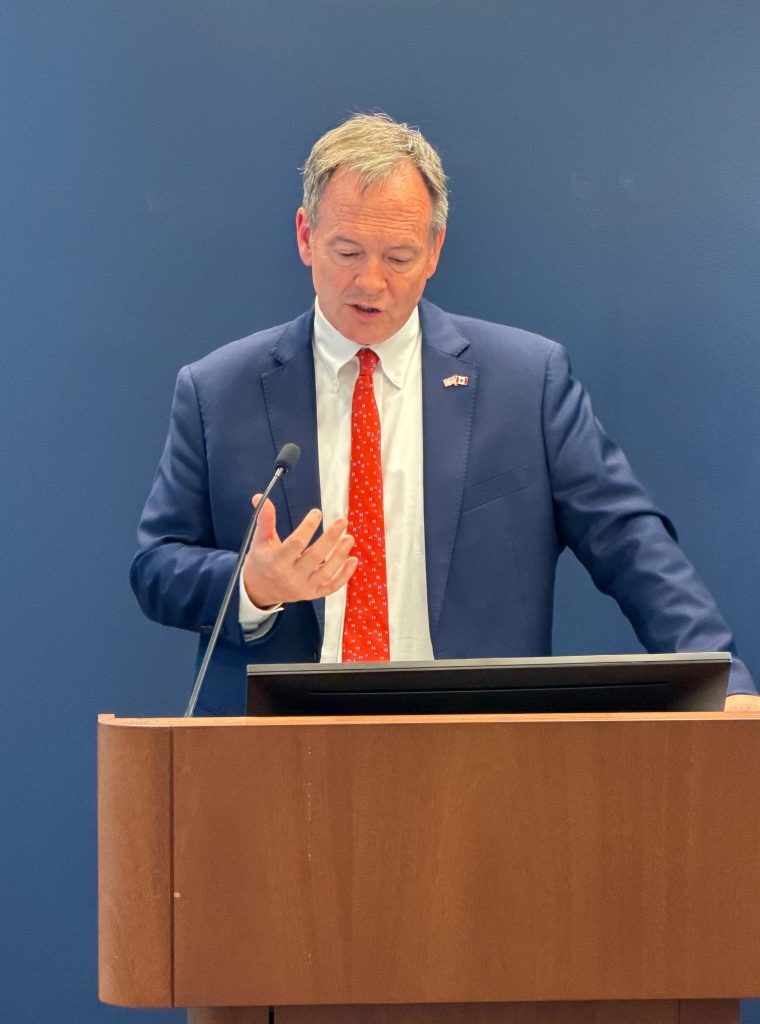
Given these challenges, Daly emphasized the importance of specialization. The age of the China generalist is over; instead, people must focus on “China and…” Although the total number of opportunities in U.S.-China policy work has decreased, the rising need for specialists has generated different kinds of opportunities, such as in cybersecurity, technology, and national security. Daly encouraged early-career professionals to widen the types of jobs they pursue, not shying away from security-related positions, as well as considering China-related work outside of DC, whether in other U.S. states or as part of broader international initiatives and campaigns. When existing organizations are insufficient, Daly advised individuals to consider establishing new institutions, initiatives, and employment opportunities.
“U.S.-China relations matter…the way this relationship unfolds, with your help, is going to be a part of remaking this world.” – Robert Daly
Daly concluded by emphasizing that pursuing meaningful U.S.-China relations work remains worthwhile despite the difficulties. He recommended that entry-level professionals explore the Public Intellectuals Program at the National Committee on U.S.-China Relations, Carnegie China Fellows Program at the University of Maryland, Penn Project on the Future of U.S.-China Relations, and Young China Watchers as potential gateways.
After Daly’s remarks, moderator Ryan McElveen turned the conversation to the panelists, asking each about their career trajectory. Holmes began by explaining how her study of Chinese at George Washington University, combined with her interest in international exchange and connecting people through language, led her to the Foreign Service. In an interconnected world in which goods, information, and ideas move between countries, she described the work of diplomats as “unclogging the pipes, identifying problems, finding solutions, and then allowing things to flow again in a way that is free.” As diplomats are hired as generalists for their ability to quickly adapt to new environments and cultures, she recommended a foreign service career for those who enjoy learning about new topics and having new experiences.
Next, Mintzer described her pathway from policy research into the corporate sector. She noted that policy research and analytical experience can provide valuable perspectives that inform corporate decision-making, while the ability to translate complex policy developments into useful insights is relevant across research and business environments. She also stressed the importance of understanding U.S.-China relations from both American and Chinese perspectives, rather than focusing solely on the U.S.’s viewpoint.
“Understanding U.S.-China relations not only from the U.S. perspective but also from the Chinese perspective–understanding U.S. politics and then what’s going on in Chinese domestic politics, and economy, and society–has been super valuable.” – McCall Mintzer
Originally from Australia, Thomas recounted his transition to the U.S. to find a broader variety of China policy research opportunities. He noted that, especially as an outsider, the U.S.’s diversity of cultures is difficult to understand and thus advised individuals to be as curious about the U.S. as they are about China. Regarding job opportunities, Thomas stressed the significance of one’s colleagues, commenting that having a boss who is a good person and supports younger people matters more than the organization or sector for which one works. Beyond people, Thomas recommended the private sector for those who enjoy analysis. Intellectual discipline may be stronger in the private sector, he said, as professionals are paid to be direct, instead of to weigh political considerations.
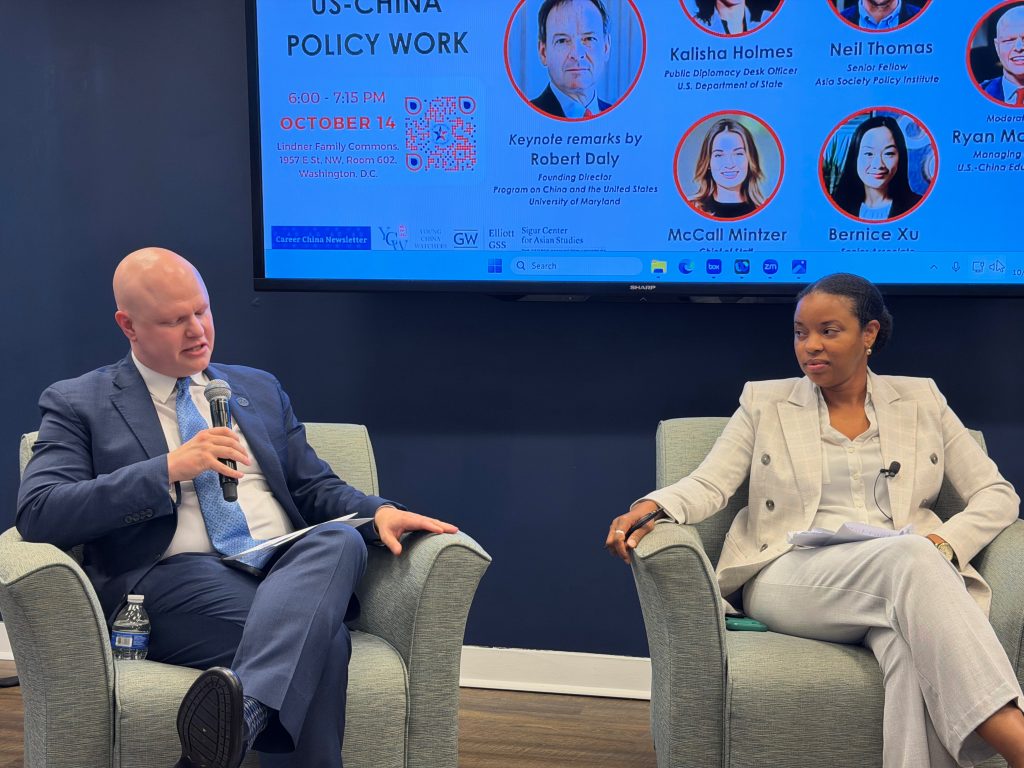
Xu, like Holmes, studied at George Washington University where she developed interest in security and China policy. After beginning her career at the Carnegie China Center in Beijing and then National Committee on U.S. China Relations in New York, she pursued a master’s degree at Georgetown University through which she obtained a fellowship at the Pentagon on Southeast Asia policy. Now, she has shifted to consulting at The Asia Group where she advises U.S. defense clients on navigating regional issues. Using her career as an example, Xu encouraged early-career professionals to remain as open minded and flexible as possible. In contrast to her three original goals–to work in government, stay in DC, and work in China policy–Xu now has worked in the private sector, in Beijing and New York, and with countries other than China. While it’s important to have a goal, looking at adjacent opportunities can open new doors.
“Even though my day-to-day job doesn’t revolve around China anymore–China is not in my job description or title–I found U.S.-China relations, and the foundation I have in that, to be incredibly useful.” – Bernice Xu
McElveen then asked how they landed their first job in the field and what specific steps young professionals should take when starting out or transitioning into a new role. Mintzer noted that graduate school is often valuable in the policy field, especially for candidates with limited experience beyond academic coursework. She emphasized that showing genuine enthusiasm about China-related issues, establishing clear professional goals, and sharing those goals with others are key to breaking into the field. Thomas added that strong writing skills are especially important for think tank and research careers. He encouraged individuals to build an informed professional presence on platforms such as X and LinkedIn, share thoughtful analysis, demonstrate intellectual engagement with their field, and become comfortable with rejection. Xu commented that early internships can help open doors to policy careers, and emphasized the importance of talking to people, building relationships, and taking initiative as mentors can recognize potential and help connect young professionals with opportunities. Finally, Holmes advised early-career professionals to remain open to different opportunities even when they do not align with original career plans.
McElveen next asked panelists about the role of mentors in their early career. Xu noted that mentors can help advance careers by providing guidance and professional connections, while Thomas commented that professional relationships with supervisors can lead to important long-term opportunities. Mintzer added that genuine professional relationships can develop through shared interest; for example, a family friend encouraged her interest and helped her obtain her first internship.
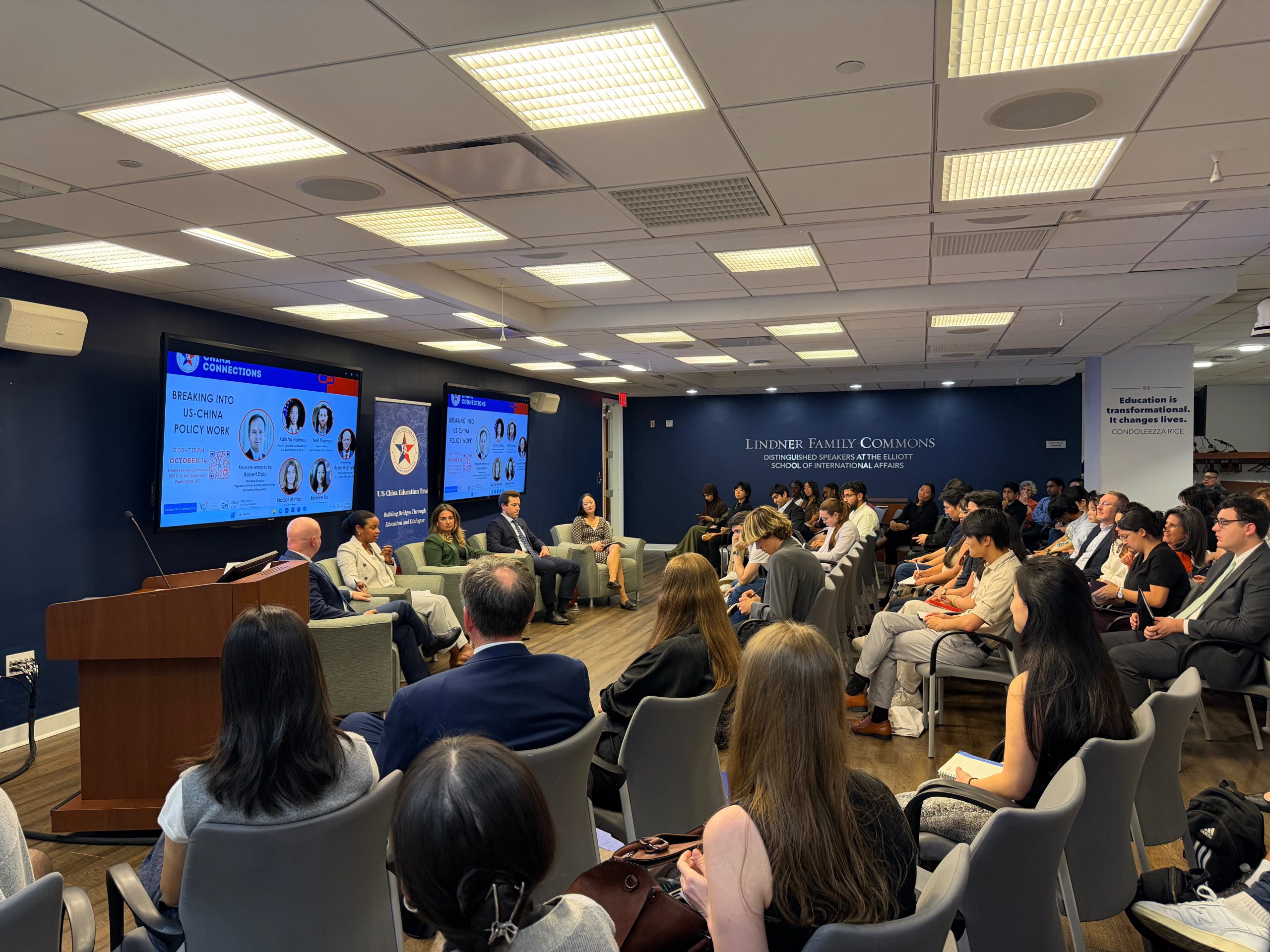
McElveen then opened the conversation to audience members who asked how entry-level candidates can stand out during the hiring process and when hired. For resumes and interviews, Holmes advised candidates to emphasize how their skills and qualifications align with the specific role they want, not only what they hope to gain from the position. Communication, the ability to learn and adapt quickly, technical proficiency, and the willingness to develop new skills are also essential qualities. Mintzer encouraged candidates to develop and refine their personal career stories, be confident in their abilities and experience, highlight the impact of their accomplishments, and demonstrate enthusiasm, intellectual curiosity, and a willingness to explore issues in-depth. She stressed that individuals must research organizations before interviewing and prepare thoughtful questions to ask interviewers. Thomas affirmed the value of demonstrating one’s ability to make a genuine contribution, and Xu highlighted the significance of multitasking and flexibility.
When asked for their advice on studying in China, panelists recommended exploring the Yenching Academy of Peking University in Beijing as well as exchange opportunities in Taiwan. Thomas encouraged students to consider studying in less internationally oriented parts of China, rather than limiting themselves to major cities. Xu and Mintzer advised students to think carefully about what they want to gain from an international study program before choosing one, including whom they hope to meet and the personal connections they hope to develop.
McElveen closed the event by thanking the panelists for sharing their experiences and offering valuable career advice. Separately, he emphasized the value of teamwork and the ability to work effectively with others. He encouraged young professionals to develop the ability to think quickly on their feet and adapt to different situations.
Speaker Biographies
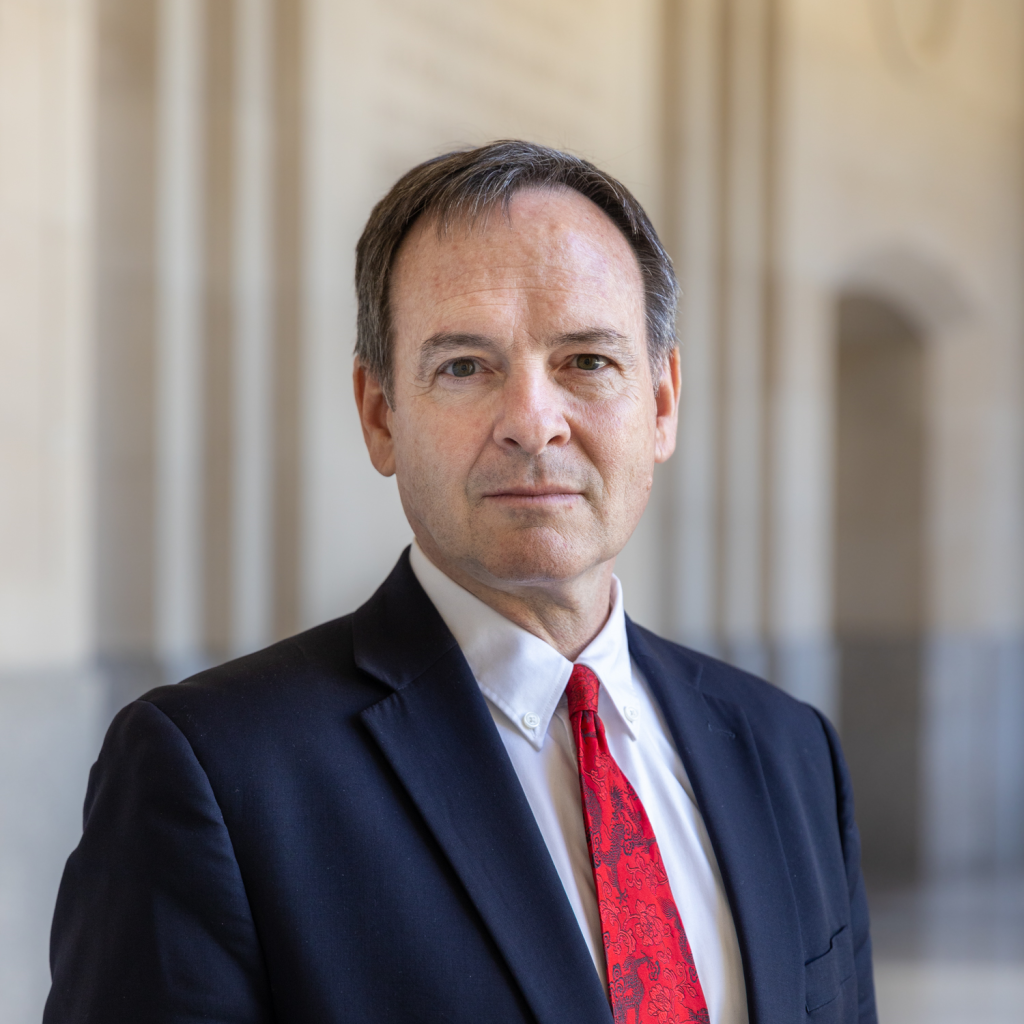
Robert Daly is a visiting professor of the practice and founding director of the Program on China and the United States at the University of Maryland School of Public Policy. He previously served as director of the Kissinger Institute on China and the United States at the Wilson Center from 2013 to 2025. Before joining the Wilson Center, Daly directed the Maryland China Initiative at the University of Maryland from 2007 to 2013. From 2001 to 2007, he served as American Director of the Johns Hopkins University-Nanjing University Center for Chinese and American Studies in Nanjing, China.
Daly began his career in U.S.-China relations as a diplomat, serving at the U.S. Embassy in Beijing in the late 1980s and early 1990s. After leaving the Foreign Service, he taught Chinese at Cornell University and worked on television and theater projects in China as a host, actor, and writer. He also helped produce a Chinese-language version of Sesame Street and directed the Syracuse University China Seminar.
Daly has extensive experience in U.S.-China relations and regularly provides analysis for major media outlets, including NPR, C-SPAN, CNN, and BBC. He is a director of the National Committee on U.S.-China Relations and the American Mandarin Society and a member of the Task Force on U.S.-China Policy. Having lived in China for more than a decade, he has interpreted for Chinese and American leaders, including Jiang Zemin, Jimmy Carter, and Henry Kissinger. His areas of expertise include U.S.-China relations, Chinese foreign policy, soft power and public diplomacy, and technology competition.
Panelists
Kalisha Holmes has been a Foreign Service Officer since 2014. She is currently a public diplomacy desk officer in the bureau of East Asian and Pacific Affairs. Prior to this assignment, she was mission spokesperson at U.S. embassy Dar es Salaam. She previously served as a Sports Diplomacy program officer, managing the Sports Envoy program which sends professional athletes and coaches overseas to work with U.S. embassies and consulates on short-term exchanges and is the Department’s primary liaison for professional North America-based sports leagues, as well as Team USA.
Kalisha has also previously served in Lagos, Nigeria and in Beijing China. At U.S. embassy Beijing, she served as a visa officer and as the Deputy Director of the Beijing American Center, a public outreach center at U.S. Embassy Beijing where she coordinated cultural programming for around 25,000 visitors a year. In Lagos, Nigeria, she was a visa officer for both immigrant and nonimmigrant visas.
She has a Bachelor’s degree in International Relations from George Washington University and a Master’s degree in Public Policy from the Kennedy School of Government at Harvard University. She speaks Mandarin Chinese and Kiswahili.

McCall Mintzer is Chief of Staff for International Operations & Policy at Boeing, where she supports the company’s international sales, strategy, and engagement. Her professional experience spans international business, public policy, and U.S.-China relations.
Prior to joining Boeing, Mintzer worked at the Brookings Institution’s John L. Thornton China Center, where she supported research on China and U.S.-China relations. Her work contributed to research and publications examining U.S.-China competition, foreign policy, governance, and broader political and economic developments in Asia.
Mintzer previously lived and studied in China, earning a master’s degree from East China Normal University in Shanghai, where her studies focused on Chinese politics, governance, political communication, and research methods. She was a recipient of a Chinese Government Scholarship and also worked with China Economic Review in Shanghai, writing and editing on developments in China’s economy, policy, business, and technology sectors. Her background combines experience in the private sector, policy research, and China-focused analysis.
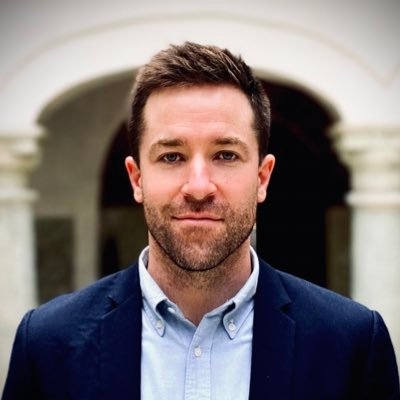
Neil Thomas is a Senior Fellow on Chinese Politics at the Asia Society Policy Institute’s Center for China Analysis, where he studies Chinese elite politics, political economy, and foreign policy. He co-leads the Center’s Decoding Chinese Politics project, which examines China’s political institutions, leadership networks, key decision-makers, and major policy trends.
Previously, Thomas served as a Senior Analyst for China and Northeast Asia at Eurasia Group and as a Senior Research Associate at MacroPolo, the Paulson Institute’s think tank. He also taught at the University of Chicago’s Harris School of Public Policy. He has testified before the U.S.-China Economic and Security Review Commission and regularly contributes analysis on Chinese politics and policy to leading publications and media outlets.
Thomas holds a Master in Public Policy from Harvard University’s John F. Kennedy School of Government and a Bachelor of Arts from the University of Western Australia. He has also studied at Renmin University, Tsinghua University, and Zhejiang University.
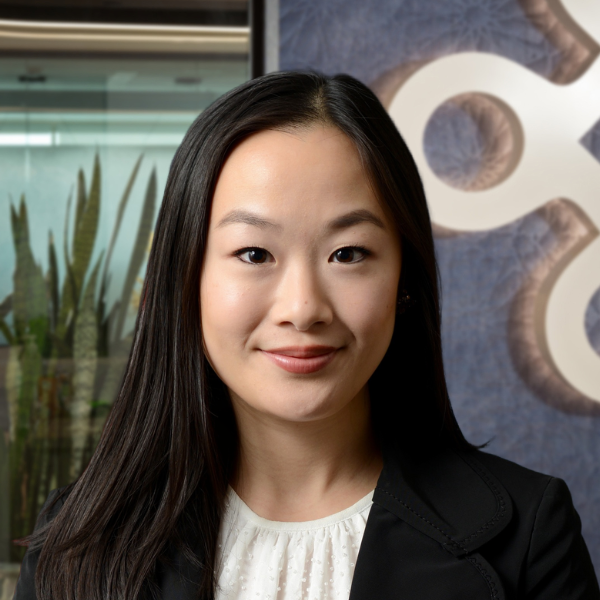
Bernice Xu is a Senior Associate with the Defense & National Security Practice at The Asia Group, where she supports defense clients across the Indo-Pacific region. Previously, she served as a Policy Advisor for Southeast Asia in the Office of the Under Secretary of Defense for Policy at the U.S. Department of Defense, focusing on U.S. defense partnerships with the Philippines, Singapore, and Indonesia. She also served as a Senior Program Associate at the National Committee on U.S.-China Relations, supporting programs including the Public Intellectuals Program, Track II dialogues, and military-security initiatives.
Xu previously worked at the National Defense University’s Center for the Study of Chinese Military Affairs and the Carnegie-China Center in Beijing. She holds an M.A. in Asian Studies from Georgetown University’s Walsh School of Foreign Service and a B.A. in International Affairs from The George Washington University. She is proficient in Mandarin Chinese.
Moderator
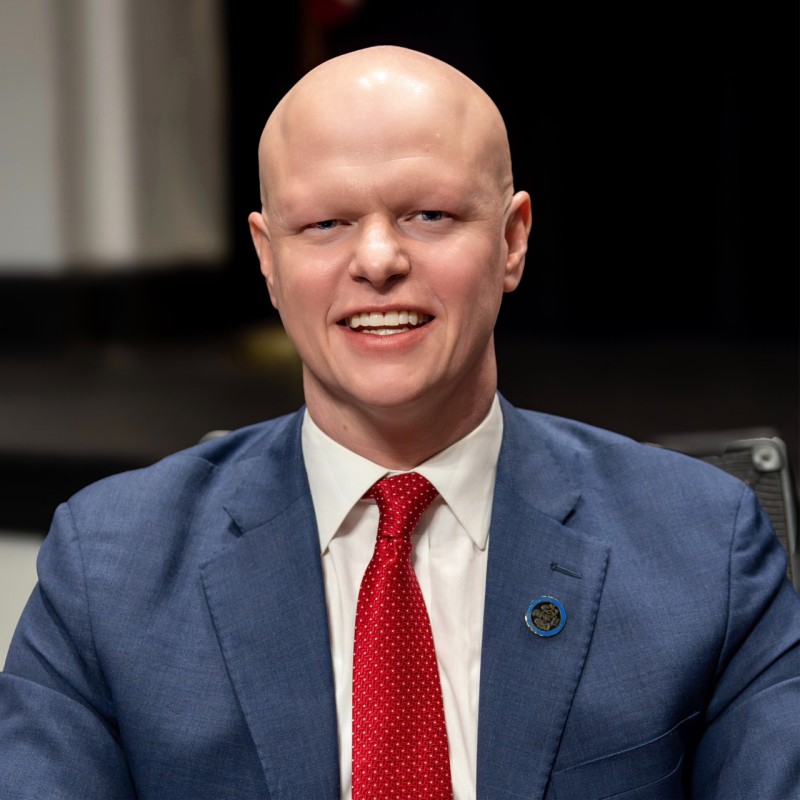
Ryan McElveen (麦瑞安) serves as the managing director for the U.S.-China Education Trust.
Ryan McElveen serves as managing director of US-China Education Trust, where he oversees organization operations, programming, communications, and development. He serves concurrently as a nonresident fellow at the Centre on Contemporary China and the World (CCCW) at the University of Hong Kong (HKU).
China Connections
Why should Americans be interested in China? USCET launches China Connections, a new monthly series hosting discussions with experts to explore their work, gain insights into current events, and learn what a career in the China field looks like today. These events highlight individuals with unique expertise on China to provide students, young professionals, and members of the public a deeper understanding of current events and increase American student interest in pursuing a focus on China. These events are mostly held in person at George Washington University with online engagement.