
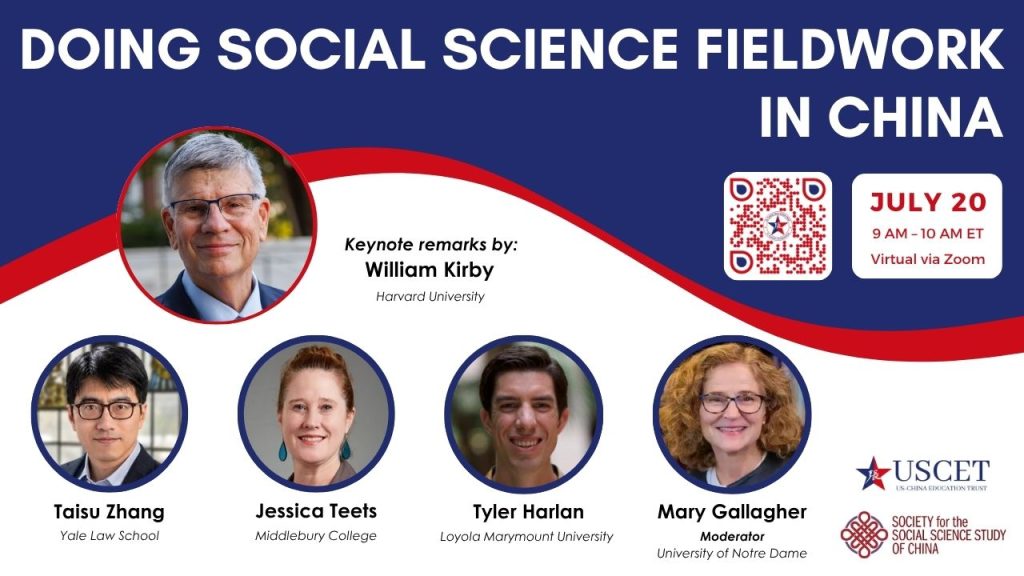
Over the last four decades, fieldwork has been critical to increasing the academic community’s understanding of China. Academic travel has resumed following the pandemic, but scholars face a more constrained academic landscape with new complexities for research methodologies such as interviews, participant observation, survey data, and obtaining archival documents.
Building on the public launch of USCET’s Resource Hub for Academic Travel in China, on Monday, July 20 at 9 AM ET, join USCET and the Society for the Social Science Study of China (SSSSOC) for a discussion with scholars who have recently undertaken social science fieldwork in China. From acquiring the requisite visa and institutional sponsorship to navigating logistical, administrative, and research-related constraints on the ground, each panelist will share practical guidance for planning and conducting research trips.
The event will open with keynote remarks from William Kirby (Harvard University) followed by a panel discussion session moderated by Mary Gallagher (University of Notre Dame) and featuring Tyler Harlan (Loyola Marymount University), Jessica Teets (Middlebury College), and Taisu Zhang (Yale Law School).
Speaker Biographies
KEYNOTE Speaker
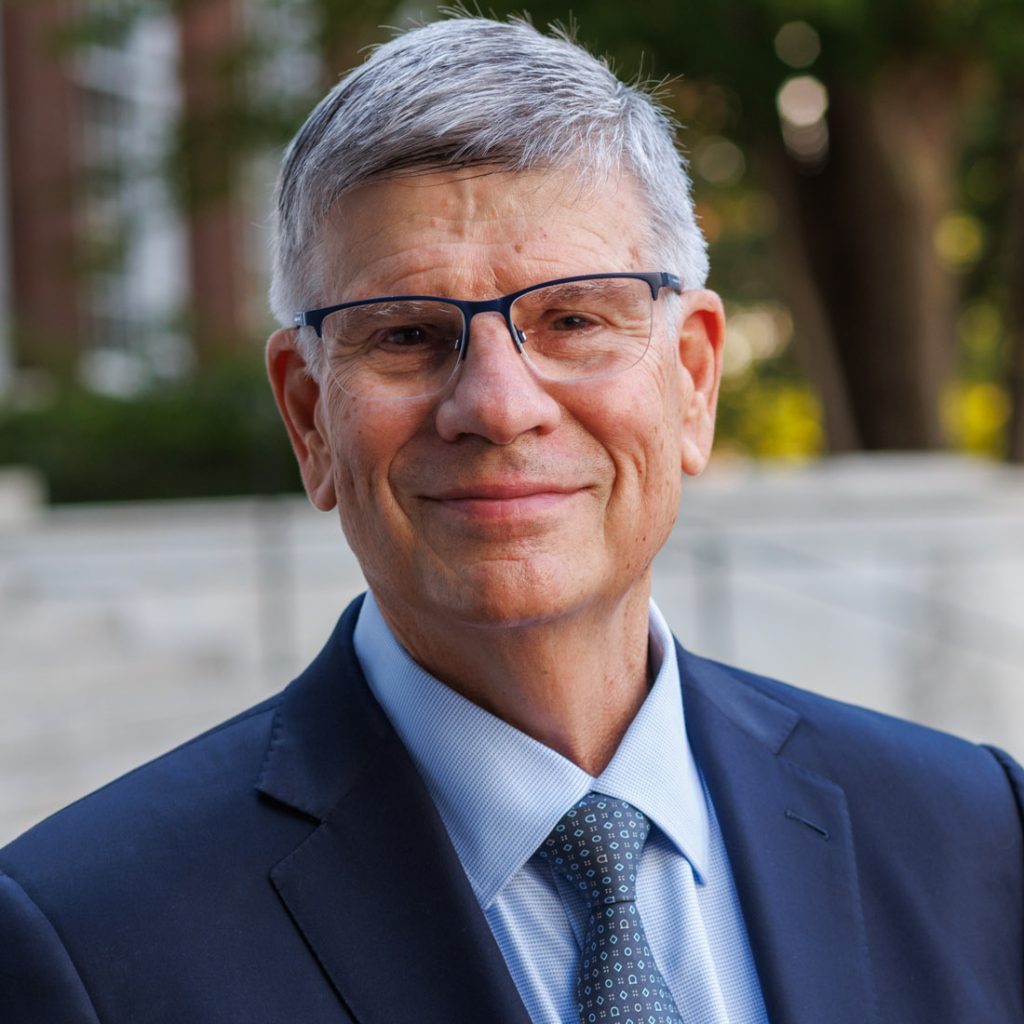
William C. Kirby is T. M. Chang Professor of China Studies at Harvard University and Spangler Family Professor of Business Administration at the Harvard Business School. He is a Harvard University Distinguished Service Professor. He serves as Chair of the Harvard China Fund and the Harvard Center Shanghai. A historian and former dean of Harvard’s Faculty of Arts and Sciences, his research and consulting focus on strategies for business and education in China. He is past chair of the Board of Directors of the American Council of Learned Societies and Harvard University Press. He presently chairs the Board of Directors of Harvard Magazine and of The Taiwan Fund, Inc. He serves on the Board of Directors of Cabot Corporation and Schwarzman Scholars at Tsinghua University. He served as Senior Advisor on China to Duke University in the founding of Duke Kunshan University and presently sits on its Advisory Board. His latest books include Can China Lead? (Harvard Business Review Press); China and Europe on the New Silk Road (Oxford University Press); and, most recently, Empires of Ideas: Creating the Modern University from Germany to America to China (Belknap Press of Harvard University Press). He is a fellow of the American Academy of Arts and Sciences.
Moderator
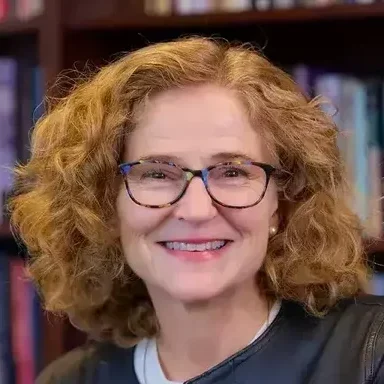
Mary Gallagher is professor of global affairs and the Marilyn Keough Dean of the Keough School of Global Affairs at the University of Notre Dame. Previously she directed the International Institute at the University of Michigan where she was also the Amy and Alan Lowenstein Chair in Democracy, Democratization and Human Rights. Gallagher earned her Ph.D. in politics from Princeton University and her B.A. in government and East Asian studies from Smith College. Her international experience includes teaching at the Foreign Affairs College in Beijing and visiting professorships at East China University of Politics and Law in Shanghai and at the KoGuan School of Law at Shanghai Jiao Tong University. She is a nonresident senior fellow at the Brookings Institution, a member of the National Committee on U.S.-China Relations, and a consultant for the U.S. Department of State, and the U.S. Department of Labor.
Panelists
Tyler Harlan is an associate professor of urban and environmental studies at Loyola Marymount University. He studies the governance and socio-environmental implications of energy transition in China and Southeast Asia. He is a Woodrow Wilson Centre China Fellow and Fulbright China Fellow, and his research has been published in The China Quarterly, Global Environmental Change and Annals of the American Association of Geographers.
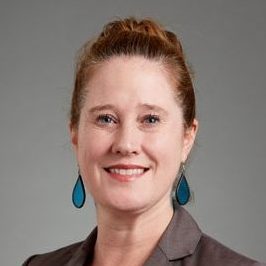
Jessica C. Teets is a Professor at Middlebury College, and Guang Biao Distinguished Chair Professor at Zhejiang University (浙江大学光彪讲座教授). Her research focuses on governance in authoritarian regimes, especially the role of civic participation and advocacy. She is the author of Civil Society Under Authoritarianism: The China Model (Cambridge University Press, 2014), editor (with William Hurst) of Local Governance Innovation in China: Experimentation, Diffusion, and Defiance (Routledge Contemporary China Series, 2014), and editor (with Max Grömping) of Lobbying the Autocrat: the Dynamics of Policy Advocacy in Nondemocracies (University of Michigan Press, 2023), in addition to articles published in The China Quarterly, World Politics, Governance, and the Journal of Contemporary China among others. Dr. Teets currently has a new book manuscript (with Dr. Xiang Gao) forthcoming on changing governance under Xi Jinping, tentatively entitled Beyond Fragmented Authoritarianism, and is organizing the 5th wave of the Civic Participation in China survey.
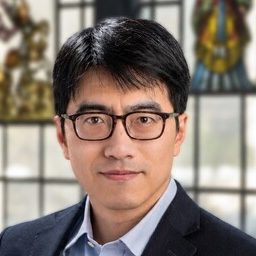
Taisu Zhang is a Professor of Law at Yale Law School and works on comparative legal and economic history, private law theory, and contemporary Chinese law and politics. He is the author of two books, The Ideological Foundations of Qing Taxation: Belief Systems, Politics, and Institutions (Cambridge University Press, 2023), and The Laws and Economics of Confucianism: Kinship and Property in Pre-Industrial China and England (Cambridge University Press, 2017). These are the first two entries in a planned trilogy of books on the institutional and cultural origins of early modern economic divergence. Zhang’s academic articles and essays have recently appeared in journals such as the Journal of Legal Studies, the Journal of Legal Analysis, the Yale Law Journal, and the Harvard Law Review. Zhang is also Global Faculty member at Peking University Law School, and has taught at the Duke University School of Law, the University of Hong Kong, Brown University, and the Tsinghua University School of Law. He serves as co-editor of Studies in Legal History, and a regular commentator on law and politics in media outlets, in both English and Chinese.